
Anthropic Just Released Claude Opus 4.7: Here Is Everything That Changed
Read Time:5 Minute, 32 Second
Anthropic dropped Claude Opus 4.7 on April 15 to 16, 2026, and this is not a minor version bump. The new model brings high-resolution image support for the first time, a new task budget system for long agentic runs, significantly better coding performance, and built-in cybersecurity safeguards. It is available right now across Claude’s products, the API, Amazon Bedrock, Google Vertex AI, and Microsoft Foundry.
This comes days after Anthropic announced Claude Mythos, the model it refused to release publicly because it was too capable. Opus 4.7 is the model they are actually shipping. Here is what changed and why it matters.

What Is New in Claude Opus 4.7
1. High-Resolution Image Support
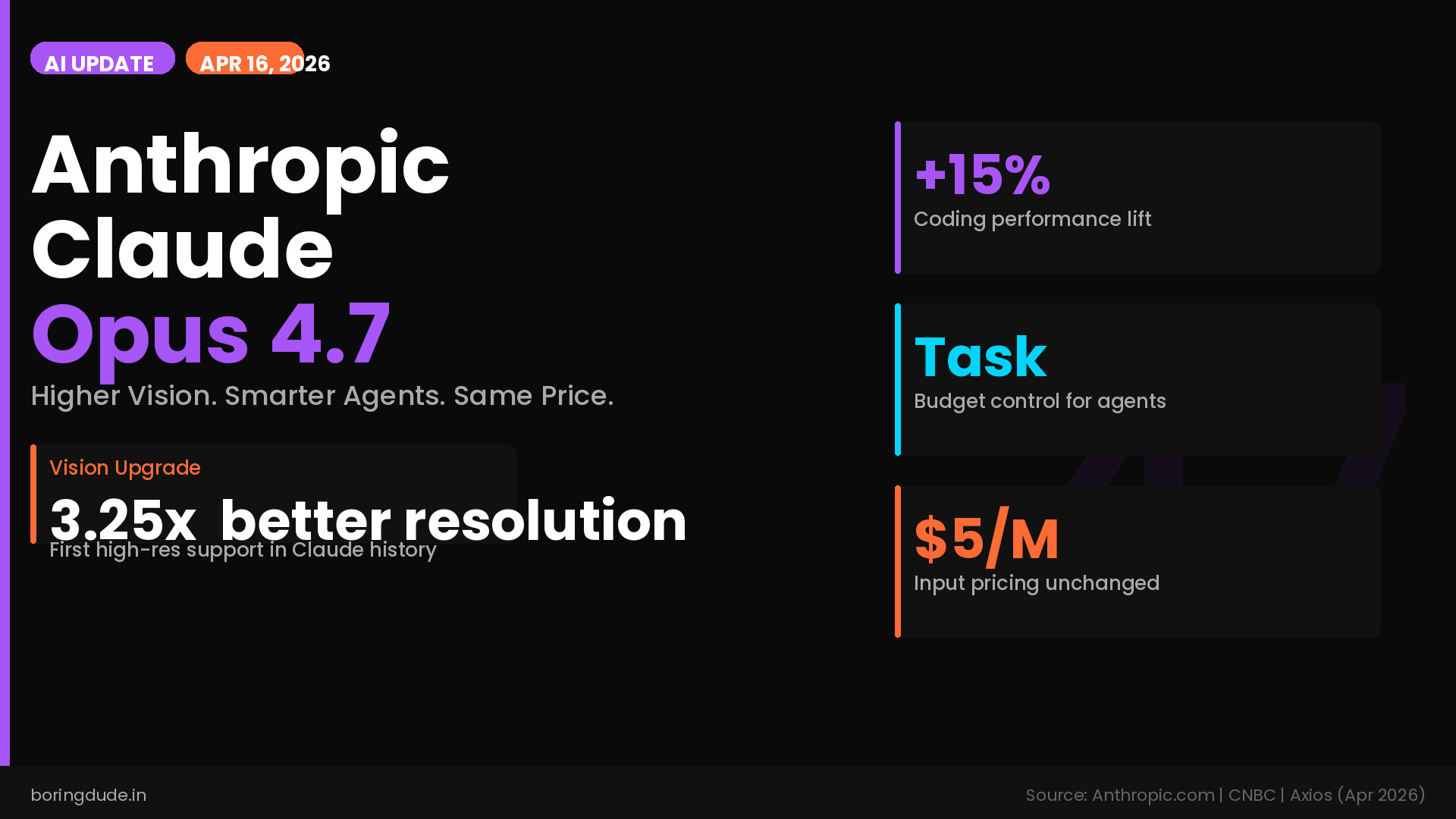
Claude Opus 4.7 is the first Claude model with high-resolution image support. Maximum image resolution is now 2576px / 3.75MP, up from 1568px / 1.15MP in Opus 4.6. That is a 3.25x increase in image resolution capacity.
Why this matters: multi-modal AI use cases, analyzing diagrams, reviewing screenshots, processing documents with visuals, reading charts and infographics, are now significantly more accurate. For developers building vision-based AI applications, this is a substantial upgrade.
2. Task Budgets for Agentic Workflows
Opus 4.7 introduces task budgets: a way to give Claude a rough estimate of how many tokens to target for a full agentic loop, including thinking, tool calls, tool results, and final output.
In plain terms: when you hand Claude a complex, multi-step task like a campaign audit, a competitive analysis, or a slide deck, you can now tell it roughly how much effort to put in. This makes long autonomous runs more predictable and more cost-controllable.
Anthropic’s own description: Opus 4.7 lets users “hand off their hardest work and return to a finished first draft” without getting lost mid-task or needing constant check-ins.
3. Significantly Better Coding Performance
Opus 4.7 delivers a 10% to 15% lift in task success over Opus 4.6 for advanced software engineering work. Fewer tool errors, more reliable follow-through on validation steps, and better performance specifically on the hardest coding tasks.
For developers who rely on Claude for code generation, debugging, and agentic coding workflows, this is a meaningful jump. The improvement is most pronounced on complex, multi-step engineering tasks where Opus 4.6 would occasionally lose context or make errors mid-sequence.
4. New Tokenizer
Opus 4.7 ships with a new tokenizer. Practically, this means it may use 1x to 1.35x as many tokens when processing text compared to previous models, up to about 35% more, depending on the content type.
For most users this will not be noticeable. For teams running high-volume API workloads, factor this into cost projections. The pricing itself is unchanged at $5 per million input tokens and $25 per million output tokens, same as Opus 4.6.
5. Built-In Cybersecurity Safeguards
Opus 4.7 automatically detects and blocks requests that indicate prohibited or high-risk cybersecurity uses. This arrives right after OpenAI launched its own cybersecurity-specialized model, GPT-5.4-Cyber, on April 14 to 15. Anthropic is responding to the same dual-use concern from the other direction: rather than creating a specialized model for security professionals, they are building safety rails into the general-purpose model.
Where You Can Use It Right Now
Claude Opus 4.7 is available across:
- Claude.ai (all Claude products)
- Anthropic API
- Amazon Bedrock
- Google Cloud Vertex AI
- Microsoft Foundry
The broad availability across all major cloud platforms from day one signals Anthropic’s maturity as an enterprise AI vendor. A year ago, new Claude models would take weeks to appear on AWS or Azure. Now it is simultaneous.
How Opus 4.7 Fits Into the Anthropic vs OpenAI Race
To understand why Opus 4.7 matters, you have to see it in context of what has happened in the last two weeks.
- April 12: Anthropic announces Claude Mythos, a model so capable it refused to release it publicly.
- April 14 to 15: OpenAI releases GPT-5.4-Cyber, a defensive cybersecurity model with binary reverse engineering capability.
- April 15 to 16: Anthropic ships Claude Opus 4.7 as the public frontier model, with improved coding, vision, and agentic capabilities.
- April 16: Stanford AI Index confirms the US-China AI performance gap has collapsed to 2.7%.
The AI release pace is accelerating. What used to take six months between frontier model updates now happens in weeks. For developers and professionals, this creates both opportunity and pressure: tools are getting better faster, but the gap between those using them and those waiting to understand them is also growing faster.
What This Means for Indian AI Professionals
Claude Opus 4.7 has direct relevance for the Indian tech market:
- Developers building AI-native applications on AWS Bedrock or Google Vertex AI can switch to Opus 4.7 immediately for better coding assistance and vision capabilities.
- Content and marketing teams using Claude for long-form agentic tasks will benefit from the task budget system, fewer runaway outputs, more predictable results.
- Indian IT companies integrating Claude into enterprise products will have access to higher-resolution image processing, which opens up document analysis, invoice processing, and visual QA use cases that were previously limited by resolution constraints.
- Pricing stayed the same. The upgrade is free for existing API users. No renegotiation needed.
Should You Upgrade from Opus 4.6?
If you are running agentic workflows, doing heavy coding work, or processing images: yes, upgrade. The improvements in all three areas are measurable and the pricing is unchanged.
If you are doing basic text tasks like summarization, drafting, or Q&A: Opus 4.6 still works fine. The jump is most significant at the complex end of the task spectrum.
One thing to watch: the new tokenizer means up to 35% more tokens per request for text-heavy workloads. Run a quick cost comparison before scaling a high-volume production workflow.
Final Thought
Claude Opus 4.7 is not Mythos. Anthropic still has a model sitting on the shelf that it believes is too powerful to release. But what it is shipping is genuinely better than what existed a week ago. Higher resolution vision, smarter agentic behavior, stronger coding, all at the same price.
In the current AI arms race, standing still for even a month means falling behind. Anthropic is not standing still.
Have you tried Claude Opus 4.7 yet? What is the first use case you are testing? Let us know in the comments.


Happy
0 %

Sad
0 %

Excited
0 %

Sleepy
0 %

Angry
0 %

Surprise
0 %
 0
0
 0
0

