
DeepSeek V4 Is Here: Open Source, 1 Million Token Context, 35x Cheaper Than Claude
Read Time:5 Minute, 14 Second
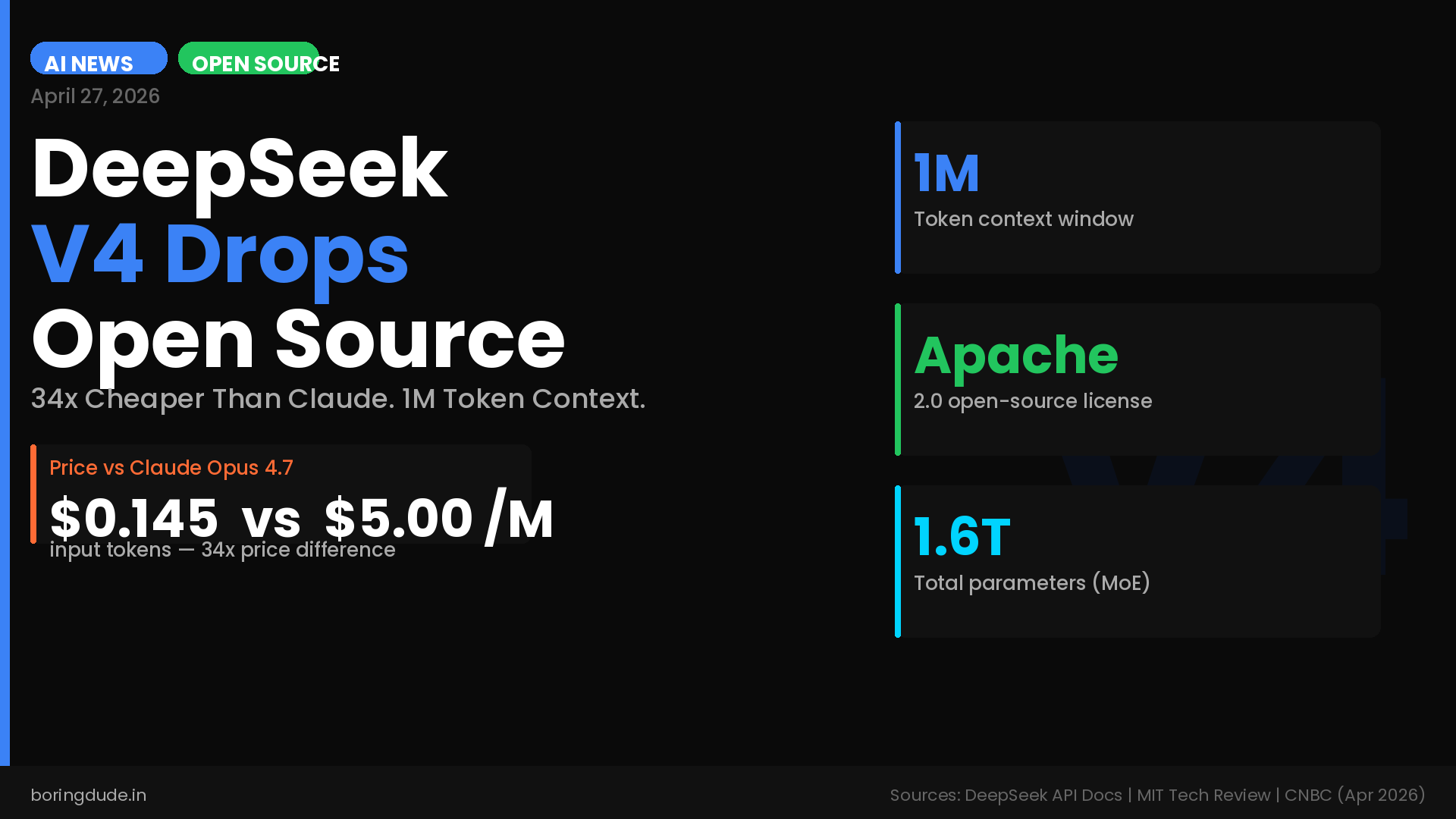
DeepSeek just launched V4 on April 27, 2026, and the pricing alone should alarm every Western AI lab. The flagship model costs $0.145 per million input tokens. Claude Opus 4.7 costs $5 per million. That is a 34x price difference for a model that DeepSeek claims rivals the best in the world. It is open source. You can run it yourself.
One year after DeepSeek-R1 briefly matched the top US model and sent stock markets into a panic, DeepSeek is back with something even more ambitious.

What Is DeepSeek V4?
DeepSeek V4 is a family of two open-source Mixture-of-Experts (MoE) large language models from Hangzhou-based DeepSeek AI. Both models support a native one-million token context window, roughly 750,000 words, or about 10 full-length novels in a single prompt.
The Two Models
- DeepSeek V4 Pro: 1.6 trillion total parameters (49 billion activated per token). The flagship is optimized for complex reasoning and agentic workflows.
- DeepSeek V4 Flash: 284 billion total parameters (13 billion activated). Lighter, faster, cheaper, built for high-volume production use cases.
Both are available on Hugging Face as open weights. Anyone can download, run locally, and fine-tune without restriction.
The Pricing That Changes Everything
This is where DeepSeek V4 becomes a major competitive event:
- DeepSeek V4 Flash: $0.14 per million input tokens, $0.28 per million output tokens
- DeepSeek V4 Pro: $0.145 per million input tokens, $3.48 per million output tokens
Compare that to the current frontier:
- Claude Opus 4.7: $5 input / $25 output per million tokens
- GPT-5.4: Comparable enterprise pricing
DeepSeek V4 Pro input pricing is 34x cheaper than Claude Opus 4.7. For teams running high-volume AI workloads, customer support agents, content pipelines, and code review bots, this is the kind of price difference that rewrites infrastructure decisions overnight.
What Makes V4 Technically Different
Hybrid Attention Architecture
V4 combines Compressed Sparse Attention (CSA) and Heavily Compressed Attention (HCA) to handle long context efficiently. In the 1M token setting, V4 Pro requires only 27% of single-token inference FLOPs and 10% of KV cache compared to DeepSeek V3.2. Dramatically more efficient at scale.
Mixture of Experts
MoE architecture means only a fraction of the model’s parameters are activated per token. V4 Pro has 1.6 trillion total parameters but activates just 49 billion at a time. This is why inference costs are low despite the massive total parameter count; you get frontier-level capability without paying for frontier-level compute on every request.
Agentic and Reasoning Upgrades
DeepSeek has specifically highlighted major upgrades to V4’s reasoning and agentic abilities. The model can act autonomously, writing code, browsing, and executing multi-step workflows, with claimed improvements over V3.2 in complex task completion. Codeforces performance improved significantly, signaling better competitive-level coding ability.
API Compatibility
V4’s API supports both the OpenAI ChatCompletions format and the Anthropic Messages format. This means switching from GPT or Claude to DeepSeek V4 requires minimal code changes. Drop-in replacement for many workflows.
Why This Matters for India
India’s developer community, AI startups, and IT services companies are disproportionately sensitive to AI API costs. Compute costs are often the bottleneck for building commercially viable AI products.
DeepSeek V4 changes that equation significantly:
- Indian AI startups building LLM-powered products can prototype and scale at a fraction of the current cost. What previously required $5,000/month in API spend can now run at $150/month.
- IT services companies building AI agents for enterprise clients can offer more competitive pricing while maintaining margins.
- Individual developers can run the open-weights version locally on consumer hardware for zero API cost.
- The 1M token context window opens up previously impractical use cases, full codebase analysis, entire document review, and long-session customer support agents.
The Open Source Angle
DeepSeek V4 is fully open-source, published on Hugging Face under an Apache 2.0-compatible license. This means:
- No vendor lock-in
- Full control over data privacy (run it on your own infrastructure)
- Ability to fine-tune for specific domains
- No API rate limits or outages
For regulated industries like finance, healthcare, and government IT, where data cannot leave the organization, running a locally deployed V4 Pro is now a practical option. A 1.6 trillion parameter model with 1M context running on your own servers was not realistic six months ago.
Should You Switch From Claude or GPT?
The honest answer: it depends on your use case. DeepSeek V4 is strong on reasoning, coding, and long-context tasks. But there are legitimate considerations:
- Data sovereignty: DeepSeek is a Chinese company. For sensitive enterprise data, review your compliance requirements before routing requests through their API.
- Safety and alignment: Open-source models have fewer built-in refusals. This is useful for developers but requires more careful application-level safety handling.
- Reliability: Anthropic and OpenAI have enterprise SLAs and proven uptime. DeepSeek’s API infrastructure is newer and less battle-tested at scale.
For cost-sensitive, non-sensitive workloads? V4 is hard to ignore at these prices. For regulated enterprise deployments? Evaluate carefully.
The Bigger Picture
DeepSeek V4, arriving one year after V-R1’s shock debut, is a signal that China’s AI efficiency advantage is not a one-time event. It is a strategy. Build world-class models at a fraction of US costs. Open-source them. Force Western labs to compete on price, not just capability.
The Stanford AI Index 2026 showed the performance gap between the US and Chinese AI had collapsed to 2.7%. DeepSeek V4 shows the price gap is even more dramatic and moving faster.
For anyone building on AI infrastructure, ignoring DeepSeek V4 because it comes from China is no longer a rational position. It requires active evaluation and a deliberate decision.
How to Get Started
- API access: Sign up at platform.deepseek.com. Supports OpenAI and Anthropic API formats.
- Open weights: Download from Hugging Face at huggingface.co/deepseek-ai/DeepSeek-V4-Pro
- Local deployment: Requires significant GPU infrastructure for V4 Pro. V4 Flash is more accessible for local runs.
Have you tested DeepSeek V4 yet? How does it compare to Claude or GPT for your use case? Drop your findings in the comments.


Happy
0 %

Sad
0 %

Excited
0 %

Sleepy
0 %

Angry
0 %

Surprise
0 %
 0
0
 0
0

