
Anthropic Files for IPO at $965 Billion. It Just Surpassed OpenAI.
Read Time:7 Minute, 26 Second
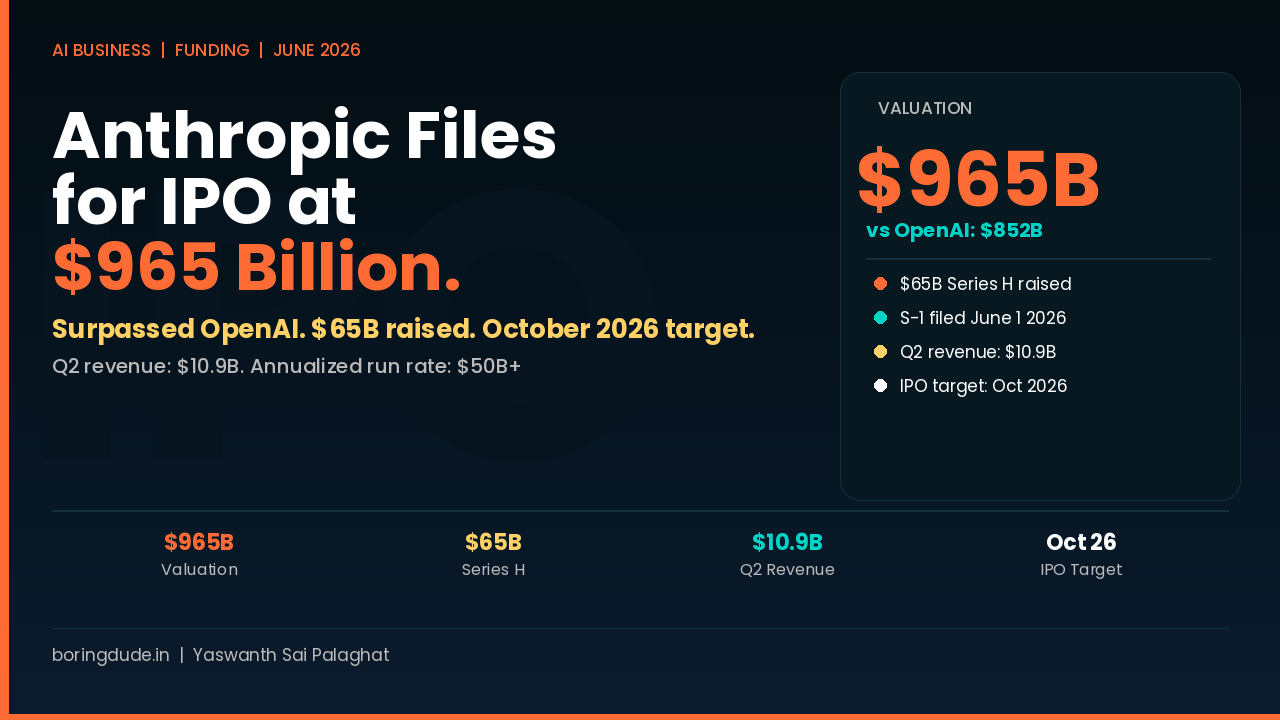
The company that makes Claude just filed for an IPO. Anthropic submitted a confidential S-1 to the SEC on June 1, 2026, making it the first major AI lab to formally begin the process of going public, and it did so at a valuation that briefly made it the most valuable AI company in the world.
At $965 billion, Anthropic overtook OpenAI’s $852 billion valuation. That number would have seemed impossible two years ago for a company largely known as “the safety-focused AI lab” and “the one that made Claude.” Today, it is a near-trillion-dollar business racing toward a Wall Street debut that could reshape how the market values artificial intelligence.
What Anthropic Just Filed and Why It Matters
A confidential S-1 filing is the first formal step toward a public offering. Companies file confidentially with the SEC to begin the review process without immediately making all financial details public. The filing gives Anthropic a path to an IPO while retaining flexibility on timing and pricing. Based on reporting from Fortune, TechCrunch, and investor briefings, the target for Anthropic’s public debut is October 2026.
The IPO would be one of the largest technology listings in years. At $965 billion, Anthropic would enter public markets near the $1 trillion mark, a threshold that only a handful of companies globally have crossed. Apple, Microsoft, Nvidia, and Alphabet are among them. An Anthropic IPO at or near that valuation would immediately place it in the conversation about the most valuable publicly traded technology companies on Earth.
The $65 Billion Funding Round That Triggered the Filing
The IPO filing followed directly from Anthropic’s $65 billion Series H round, which closed in late May 2026. The round was co-led by Altimeter Capital, Dragoneer, Greenoaks, and Sequoia Capital, with additional participation from Capital Group, Coatue, D1 Capital Partners, Baillie Gifford, Blackstone, Brookfield, D.E. Shaw Ventures, DST Global, and Fidelity Management and Research.
The breadth of that investor list is notable. This is not a round dominated by tech-focused venture funds. Blackstone, Brookfield, Baillie Gifford, and Fidelity represent institutional money, pension funds, asset managers, and global investment firms that do not typically participate in early-stage AI bets. Their presence in the Series H signals that Anthropic’s story has crossed from “promising AI startup” to “institutional-grade asset.”
The $65 billion raised is itself a record for a private AI company. For context, OpenAI’s $122 billion round earlier in 2026 was the largest single funding round in startup history. Anthropic’s Series H at $65 billion is the second largest. These are not venture rounds. They are pre-IPO institutional placements at a scale that was unthinkable three years ago.
The Revenue Numbers Are Extraordinary
Anthropic’s revenue trajectory is what justifies the valuation. The company expects to report $10.9 billion in revenue for Q2 2026, more than double the prior quarter. It has told investors that its annualized run rate will surpass $50 billion by the end of June 2026.
To put that in context: Anthropic surpassed $1 billion in annualized revenue in late 2024. It crossed $5 billion in 2025. It is now on a path to $50 billion annualized within 18 months of that $5 billion milestone. The growth rate is nearly unprecedented for a software business at this scale.
The primary driver of that growth is Claude Code and enterprise adoption. Claude Code, Anthropic’s AI coding agent for developers, has become one of the most widely used AI development tools in the market, with a developer community that has expanded aggressively through 2026. Enterprise contracts, API usage, and direct consumer subscriptions have all scaled simultaneously.
How Anthropic Overtook OpenAI in Valuation
OpenAI was valued at $852 billion in March 2026 after closing a $122 billion funding round. That round, backed by SoftBank, made it the largest private fundraising in history and was seen as cementing OpenAI’s position as the dominant AI company by market capitalization.
Anthropic’s Series H at $965 billion changed that picture three months later. The shift reflects several things that have happened in the AI market over the first half of 2026.
First, Claude’s market position has strengthened significantly. ChatGPT maintains the largest share of worldwide AI chatbot traffic at 54.7 percent, but Claude has been the fastest-growing major AI model, expanding its share by over 300 percent in a single quarter, according to web traffic data. Claude is the preferred AI for a growing segment of developers, researchers, and enterprise users who prioritize capability on complex reasoning and coding tasks.
Second, Anthropic’s safety-first positioning has become a commercial advantage rather than a constraint. Regulated industries like finance, healthcare, legal, and government are increasingly choosing Claude for enterprise deployments specifically because of Anthropic’s track record on safety and compliance. The Colorado Consumer Protections for Artificial Intelligence Act, which takes effect June 30, 2026, is one of several regulatory frameworks being written with the assumption that AI systems need stronger oversight. Anthropic has spent years building the research and policy infrastructure that positions it well in that environment.
Third, the announcement of Project Glasswing, Anthropic’s AI security project that identified thousands of zero-day vulnerabilities across major operating systems and browsers, including a 27-year-old bug in OpenBSD, demonstrated that Claude’s capabilities extend well beyond consumer chatbot use cases into serious enterprise and government security applications.
What an IPO at This Valuation Means
An Anthropic IPO at or near $1 trillion would be a defining moment for AI as an asset class. Public markets have watched the AI investment boom from the outside for three years, with funding rounds happening at private valuations that could not be easily bought or sold. An Anthropic IPO would give public market investors direct access to one of the two leading AI labs for the first time.
The IPO also changes the competitive dynamics. Public companies face quarterly earnings pressure, shareholder scrutiny, and transparency requirements that private companies do not. OpenAI, still private, operates with more flexibility in how it manages costs, investments, and strategic pivots. A public Anthropic would need to demonstrate consistent revenue growth and a credible path to profitability in a way that private AI labs have not yet been required to do.
That is not necessarily a disadvantage. Anthropic’s revenue trajectory, doubling quarterly, approaching $50 billion annualized — is the kind of growth curve that public markets respond to strongly. If the numbers hold through Q3, the IPO could be one of the most oversubscribed listings in recent memory.
The Broader Race to Go Public
OpenAI has been discussed as a potential IPO candidate throughout 2025 and 2026, but has not yet filed. Its transition from a nonprofit structure to a capped-profit and now a conventional for-profit corporation created governance complexity that delayed any public market timeline. CEO Sam Altman has said that an IPO is a possibility but not an immediate priority.
If Anthropic goes public in October 2026 as targeted, it would complete the transition ahead of OpenAI, a meaningful reversal of the narrative that OpenAI is the industry’s dominant player and Anthropic the challenger. Arriving on public markets first, at a near-trillion valuation, with a revenue trajectory that is arguably cleaner than OpenAI’s more diverse and less predictable revenue mix, positions Anthropic as a credible co-leader of the AI industry rather than a fast follower.
What This Means for the AI Industry
The Anthropic IPO is a signal that the AI investment cycle has matured to a point where institutional public markets are ready to absorb it. The venture and private equity phase of AI, characterized by enormous private rounds, opaque valuations, and limited public disclosure, is giving way to a more visible, accountable, and broadly accessible version of the AI economy.
For developers, researchers, and enterprise customers, an Anthropic IPO changes the long-term picture. Public companies have different incentives around product pricing, availability, and stability than private ones. Shareholders expect sustainable margins. That pressure can push a company toward pricing discipline and platform reliability in ways that benefit customers who have built products and workflows on top of Claude.
For the broader market, a successful Anthropic IPO near $1 trillion would validate the AI investment thesis at the highest possible level. It would make the case that the most valuable companies being built right now are AI companies — and that the gap between their private valuations and what public markets are willing to pay is closing.
October 2026
That is the current target. Between now and then, Anthropic will complete the SEC review process, finalize its prospectus, conduct an investor roadshow, and price its shares. Between now and then, the company also needs to sustain the revenue growth that makes the valuation defensible.
The S-1 has been filed. The race is on. The first AI lab IPO is coming, and it will not be the last.


Happy
0 %

Sad
0 %

Excited
0 %

Sleepy
0 %

Angry
0 %

Surprise
0 %
 0
0
 0
0

