
Stanford AI Index 2026: China Has Nearly Erased America’s AI Lead
Read Time:5 Minute, 15 Second
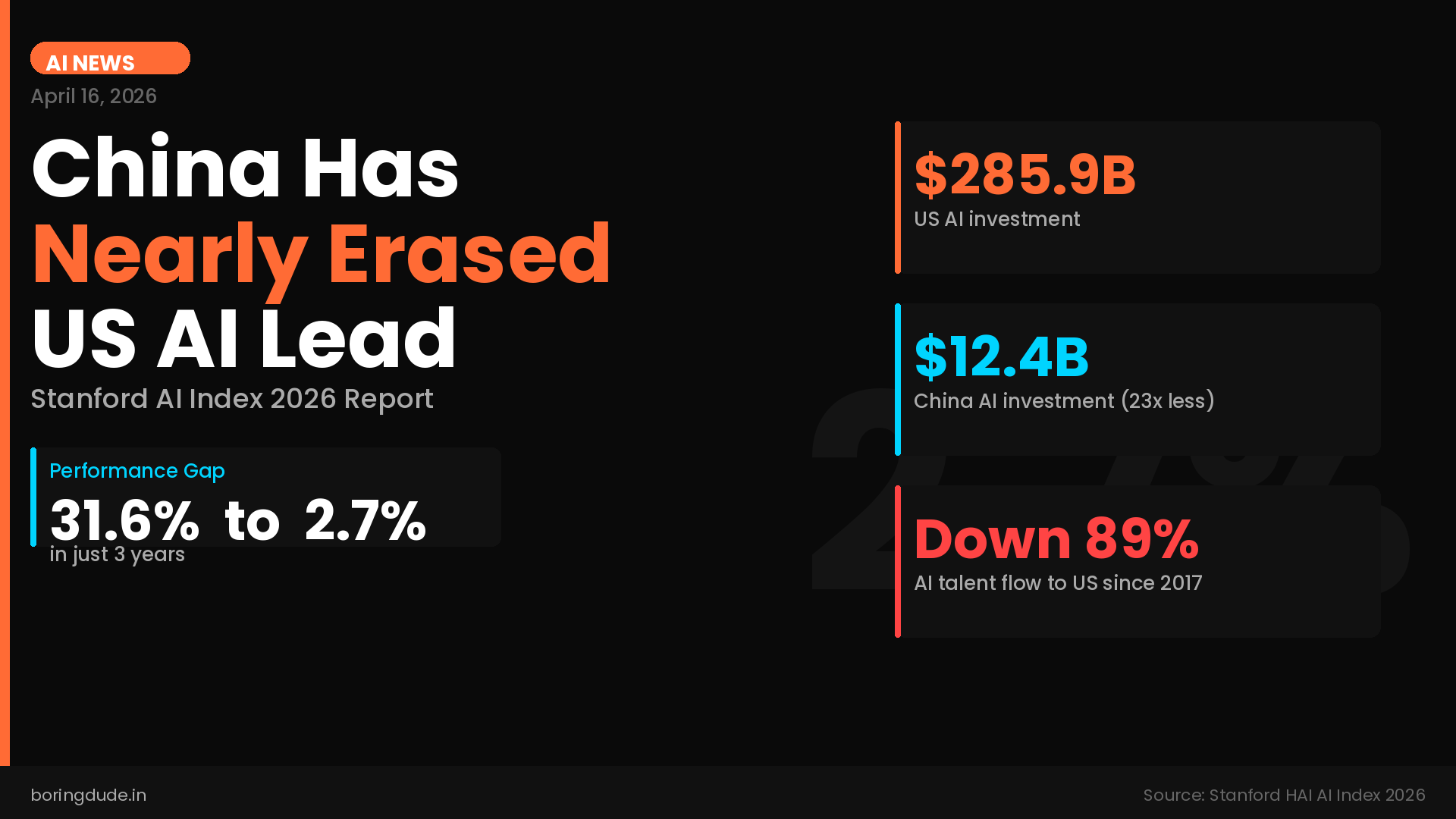
America’s AI lead over China is almost gone. That is the finding from the Stanford HAI AI Index 2026 report, released today on April 16, 2026. The performance gap between the best American and Chinese AI models has collapsed from 31.6% to just 2.7%. And China got there while spending 23 times less money.
This is not a minor development. This is a geopolitical shift with direct consequences for every tech company, every AI researcher, and every country betting on one side of this race.

The Numbers That Tell the Story
In May 2023, OpenAI’s GPT-4 led Chinese AI models by more than 1,300 Arena points on head-to-head benchmarks. By March 2026, that gap had shrunk to just 39 Arena points. The US still technically leads, but the margin is now effectively a rounding error in the context of where both sides were three years ago.
Here is the full data picture from the Stanford report:
- Performance gap: Collapsed from 31.6% to 2.7%
- US private AI investment: $285.9 billion
- China private AI investment: $12.4 billion (23x less)
- China share of global AI patents: 69.7%
- China share of global AI publications: 23.2%
- China industrial robot installations: 9x the rate of the US
- AI talent migrating to the US: Down 89% since 2017
China is not winning on funding. It is winning on output efficiency, patent volume, research volume, and industrial deployment. The US is outspending China by a massive margin but the performance results are nearly identical.
The Moment China Sent a Warning Shot
The turning point was February 2025. DeepSeek-R1, a Chinese AI model, briefly matched the performance of the top US model. The AI world took notice. US stocks dropped. Policymakers panicked. And the conversation shifted from “how far ahead is the US” to “is the US still ahead at all.”
Since then, US and Chinese models have traded the top position multiple times. As of March 2026, Anthropic’s leading model holds a 2.7% performance edge. That number can flip in a single model release.
Where China Is Actually Ahead
The Stanford report does not just talk about where the US leads. It is equally clear about where China has already won.
AI Patents
China files 69.7% of all global AI patents. The US is not even close on this metric. Patents matter because they represent applied, commercializable AI innovation, not just research. China is building a legal moat around its AI applications at a scale the US has not matched.
Research Volume
China accounts for 23.2% of global AI publications. While the US produces higher-impact research by citation count, China’s sheer volume of output means more experiments, more applications, and more surface area for breakthrough discoveries.
Physical AI and Robotics
China installs industrial robots at 9 times the rate of the US. If you believe, as many researchers do, that physical AI and robotics are the next major frontier after large language models, China has a significant head start in real-world deployment infrastructure.
Energy Infrastructure
The report highlights China’s energy infrastructure advantage for AI. Training frontier AI models requires massive power. China has built energy capacity at a scale that will matter enormously as AI compute demands continue to increase.
The Talent Problem Nobody Is Talking About
One of the most alarming findings in the Stanford report is about AI talent flow. The number of AI researchers migrating to the United States has dropped by 89% since 2017.
The US built much of its AI advantage on attracting the world’s best minds. That pipeline is drying up. Whether because of visa restrictions, geopolitical tensions, or simply improving opportunities in other countries, the talent advantage the US has relied on is shrinking fast.
For Indian AI researchers and engineers, this has direct implications. India has historically been one of the largest sources of AI talent for US companies. That talent flow, and the career opportunities tied to it, is now less certain than it was five years ago.
What This Means for Indian IT and Tech Professionals
India sits in an interesting position in this competition. Indian IT companies serve both US and global markets. Indian engineers power AI teams at Google, Microsoft, Meta, and Anthropic. But the geopolitical dynamics are shifting in ways that could reshape those relationships.
A few things worth watching:
- AI job demand in India is partly driven by US companies offshoring AI development. If US AI leadership weakens, the competitive pressure to offshore may shift.
- Chinese AI tools are becoming genuine alternatives to US products in cost-sensitive markets. Indian companies may increasingly evaluate both.
- India’s own AI ambitions, including investments like Sarvam AI’s $1.5 billion valuation, become more significant if the US-China duopoly shows cracks.
- Talent strategy matters more as the global competition for AI researchers intensifies. Indian engineers are in demand everywhere.
The US Still Has Advantages, But They Are Not Permanent
Stanford’s report is not a declaration that China has won the AI race. The US still produces more top-tier AI models. It still has the highest private investment. Silicon Valley’s startup ecosystem and venture capital infrastructure remain unmatched. OpenAI, Anthropic, Google DeepMind, and xAI are all US-based.
But the strategic assumption that the US had a comfortable, durable lead has been proven wrong. The 31.6% performance gap that existed three years ago is now 2.7%. At that rate of convergence, the idea of a permanent US AI advantage is not credible.
The race is genuinely open. And that changes everything for policy, investment, hiring, and how the next decade of technology gets built.
Final Thought
The Stanford AI Index 2026 does not predict who will win the AI race. What it does, very clearly, is prove that the race is much closer than anyone in the US establishment wanted to admit. China built near-parity while spending 23 times less money. That is not luck. That is strategy, execution, and institutional commitment at a scale the world should take seriously.
The next model release from any major lab could flip the 2.7% gap. Watch this space.
What do you think about the US-China AI race? Drop your take in the comments.


Happy
0 %

Sad
0 %

Excited
0 %

Sleepy
0 %

Angry
0 %

Surprise
0 %
 0
0
 0
0

