
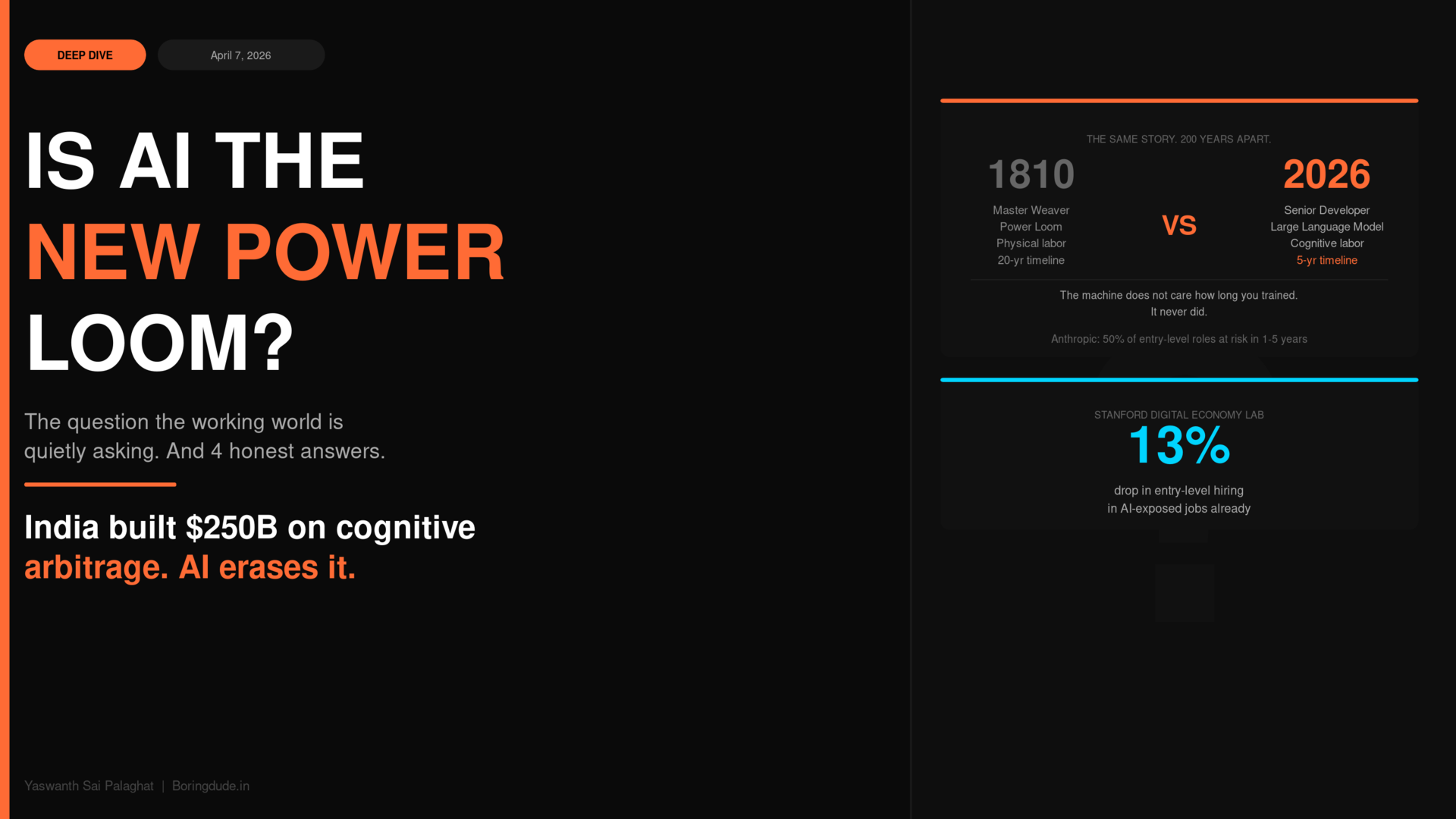
Is AI Doing to Knowledge Workers What the Industrial Revolution Did to Craftsmen?
Read Time:10 Minute, 20 Second
In 1810, a master weaver in Yorkshire spent 10 years learning his craft. He could produce fabric of a quality and consistency that no beginner could replicate. His skill was his livelihood. His identity. His insurance policy against poverty.
Then the power loom arrived.
Within a decade, what took him 10 years to learn was being done by a machine operated by a 14-year-old. Not better, not worse. Just cheaper. Much, much cheaper.
Now fast forward to 2026. A senior developer with 8 years of experience. A copywriter who spent 6 years building a portfolio. A financial analyst who mastered Excel models across 4 companies. An entry-level paralegal who just cleared the bar.
GitHub Copilot writes code. Claude writes copy. AI models run financial analyses. LLMs draft legal documents.
The question the entire working world is quietly asking right now: Is this the same story? Or is something fundamentally different this time?
I have been sitting with this question for weeks. And I do not think there is one clean answer. There are four. And all four are worth understanding.

The Parallel That Should Make Every Knowledge Worker Pay Attention
The Industrial Revolution did not just replace physical labor. It replaced skilled physical labor. That is the part most people forget.
The craftsmen who lost their livelihoods were not unskilled day laborers. They were the best at what they did. Weavers, cobblers, typesetters, carriage makers. These were people with decades of hard-won expertise. The industrial machine did not care.
What is happening in knowledge work right now follows the same logic.
According to research from Anthropic, AI could eliminate nearly 50% of entry-level professional positions within 1 to 5 years. The Stanford Digital Economy Lab found that hiring in AI-exposed jobs has already dropped 13% since large language models became mainstream. Goldman Sachs estimates 6 to 7% of US workers could lose their roles to AI adoption. Wall Street banks alone are planning to cut approximately 200,000 jobs over the next 3 to 5 years, mostly in entry-level and back-office roles.
And this is with AI still in its early years.
The parallel is not just structural. It is emotional. When workers in the 1800s saw factories rise, the dominant response was denial, followed by anger, followed by desperate adaptation. Sound familiar?
We are somewhere between denial and anger right now. The adaptation phase has not fully begun.
The Four Opinions Worth Having
When I talk to people about this, four very different positions keep emerging. None of them is entirely wrong. That is what makes this conversation worth having.
Opinion 1: History Is Repeating, and Most Workers Will Not Come Out on Top
This is the uncomfortable position. The one that gets dismissed as pessimism but deserves serious attention.
Here is what the optimists about the Industrial Revolution tend to gloss over. Yes, it created new jobs in the long run. Yes, overall standards of living rose over the decades. But for the individual weaver who lost his income in 1815, those long-run statistics meant nothing. He was 45 years old, his skills were worthless, and retraining programs did not exist yet.
The transition period was brutal for actual people, even if the aggregate outcome was positive.
Today, entry-level developers, junior analysts, content writers, and paralegals are the new weavers. The transition period for them is happening right now. And unlike the Industrial Revolution, which took 80 years to fully play out, AI is moving in 5 to 10-year cycles. The window to adapt is dramatically shorter.
If you are in your 30s or 40s in a knowledge-work role today, waiting for the long-run optimistic outcome may not be a strategy. It may be a gamble.
Opinion 2: The Optimists Were Right Then, and They Are Right Now
Here is the counter. The Industrial Revolution created far more jobs than it destroyed. It just took time, and the jobs looked completely different.
In 1800, there was no such thing as an electrical engineer, a factory floor manager, a locomotive designer, or a telegraph operator. These professions did not exist. The disruption created the demand for entirely new categories of skill that nobody could have predicted.
The same logic applies today. Prompt engineers, AI trainers, AI output auditors, human-in-the-loop reviewers, AI ethics consultants, and AI system integrators. These roles did not exist 5 years ago. The World Economic Forum estimates AI and automation will create 11 million new jobs by 2030, even as they displace 9 million.
The argument here is not that nothing changes. It is that the nature of valuable work changes, and the people who move toward the new categories of value win.
Every major technological shift in history has eventually produced more work, not less. The ATM was supposed to eliminate bank tellers. Bank teller employment actually increased for two decades after ATMs rolled out because branches expanded and the cost of running a branch dropped.
The optimists are not naive. They are reading the historical data correctly.
Opinion 3: This Time Is Genuinely Different, and We Need to Stop Pretending Otherwise
This is the position I find most intellectually honest and also the most uncomfortable.
Every previous technological disruption replaced physical capability. Muscles, dexterity, repetitive physical motion. The Industrial Revolution automated weaving. The tractor automated farming. The assembly line is an automated manufacturing.
In every case, humans retained one clear advantage: cognitive work. The ability to think, reason, create, judge, and communicate. That was the layer above automation. That was always the safe zone.
AI is automating the cognitive layer.
For the first time in the history of technological disruption, the thing being automated is the thing that made humans uniquely valuable compared to machines. There is no obvious next layer to retreat to. Physical labor has been automated. Routine cognitive labor is being automated. What remains?
Columbia Business School research describes this as AI commodifying expertise itself. The knowledge and judgment it took years to develop can now be replicated computationally at scale.
This does not mean humans have no value. It means the premium on human cognitive work is going to narrow in ways that do not have a clean historical precedent. The old playbook of “learn a harder skill and move up” may not work when AI moves up at the same pace you do.
Opinion 4: The Real Problem Is Not Job Loss, It Is Who Owns the Machine
The fourth position is the one that gets discussed least because it is the most political. But it is also the most structurally important.
During the Industrial Revolution, the machines were owned by industrialists. Workers gained some share of the productivity gains through wages and, eventually, through labor movements and legislation. It took about a century and enormous conflict to reach something resembling equilibrium.
Today, the AI infrastructure is owned by a small number of companies. OpenAI, Anthropic, Google, Microsoft, Meta. The productivity gains from AI are, right now, accruing almost entirely to those companies and their shareholders.
A freelance developer who uses GitHub Copilot to work 3 times faster does not earn 3 times more. The company that hired them charges the client more, or replaces the developer with one-third of the staff.
The question of who benefits from AI-driven productivity is not a technology question. It is a political economy question. And the historical precedent suggests that without deliberate structural responses, the benefits will concentrate upward while the disruption spreads downward.
What This Means for India Specifically
This conversation lands differently in India than it does anywhere else in the world. And that asymmetry matters enormously.
India built a $250 billion IT industry on a single core advantage: cognitive arbitrage. We could deliver knowledge work at a fraction of what it costs in the US or Europe. TCS, Infosys, Wipro, and the entire services industry that employs millions of Indian professionals were built on that single structural advantage.
AI erases cognitive arbitrage.
If a US company can use AI to do in two hours what previously required a 10-person team in Hyderabad, the entire economic logic that built Indian IT disappears. Not gradually. Rapidly.
This is not speculation. IT services revenue growth has already slowed. Freshers are finding that entry-level tech jobs require AI proficiency as a baseline, not as a bonus. Companies that previously hired 10,000 freshers per year are hiring 3,000. The ones they are hiring are the ones who can work effectively alongside AI tools, not the ones who are waiting to be taught.
The Industrial Revolution created a new industrial middle class in England. It also devastated the economies of India’s traditional textile industry at the same time, because English factory-made cloth could undercut Indian handloom weavers on price globally. India was on the wrong side of that disruption for 150 years.
The question India needs to answer in the next 5 years is whether it will find a position of advantage in the AI economy or whether it will once again be on the wrong side of a technological shift driven by decisions made elsewhere.
The One Lesson From 1810 That Actually Applies
When the power loom arrived, the workers who fared best were not the ones who tried to out-weave the machines. And they were not the ones who smashed the looms (though many tried). They were the ones who figured out what the machine could not do and built a livelihood around that gap.
The machines could produce volume. They could not produce quality judgment, customer relationships, design taste, or the ability to spot what a specific buyer actually wanted versus what could be mass-produced.
The weavers who survived became fabric merchants, pattern designers, quality inspectors, and boutique producers of high-end handmade goods that commanded a premium precisely because they were not machine-made.
The parallel for knowledge workers is direct. AI can produce volume. It produces decent first drafts, functional code, standardized analyses, and templated outputs at extraordinary scale and speed.
It cannot reliably produce genuine creative judgment, deep client understanding, ethical accountability, originality that surprises, or the kind of trust that comes from a human relationship built over time.
The knowledge workers who will fare best are not the ones trying to compete with AI on volume or speed. They are the ones building skills and positioning in the gaps that AI does not fill. Taste. Judgment. Accountability. Relationships. Originality.
These are not soft skills. They are the hardest skills. And they are about to become the most valuable ones.
Where I Land On This
I think all four opinions are partially correct. Which is uncomfortable, but honest.
Yes, history is repeating. The pattern of disruption, denial, and adaptation is identical to what happened 200 years ago.
Yes, the optimists have historical data on their side. New jobs will emerge. Some already are.
Yes, this time is different in one critical way. Cognitive work has never been the target before. The speed of disruption is also genuinely faster than anything the industrial transition produced.
Yes, the ownership question matters enormously and will determine whether AI-driven productivity gains are broadly shared or narrowly concentrated.
What I am certain about is this: waiting is not a strategy.
The master weavers who waited for the factories to go away did not survive the transition. The ones who moved before they had to were the ones who shaped what came next.
The window to position yourself on the right side of this shift is open. The question is whether you are using it.
I Want to Know What You Think
This is one of those questions where I genuinely do not think there is one right answer. The honest position is that all four of these perspectives contain something true.
So I want to know where you land.
Are you in the camp that says this is just history repeating, and the optimists will be proved right? Or do you think the cognitive layer being automated is genuinely different from everything that came before? Is the ownership question the real issue we are not talking about? Or is the India-specific angle the most urgent part of this?
Drop your take in the comments. I read every single one.


Happy
0 %

Sad
0 %

Excited
0 %

Sleepy
0 %

Angry
0 %

Surprise
0 %
 0
0
 0
0

