
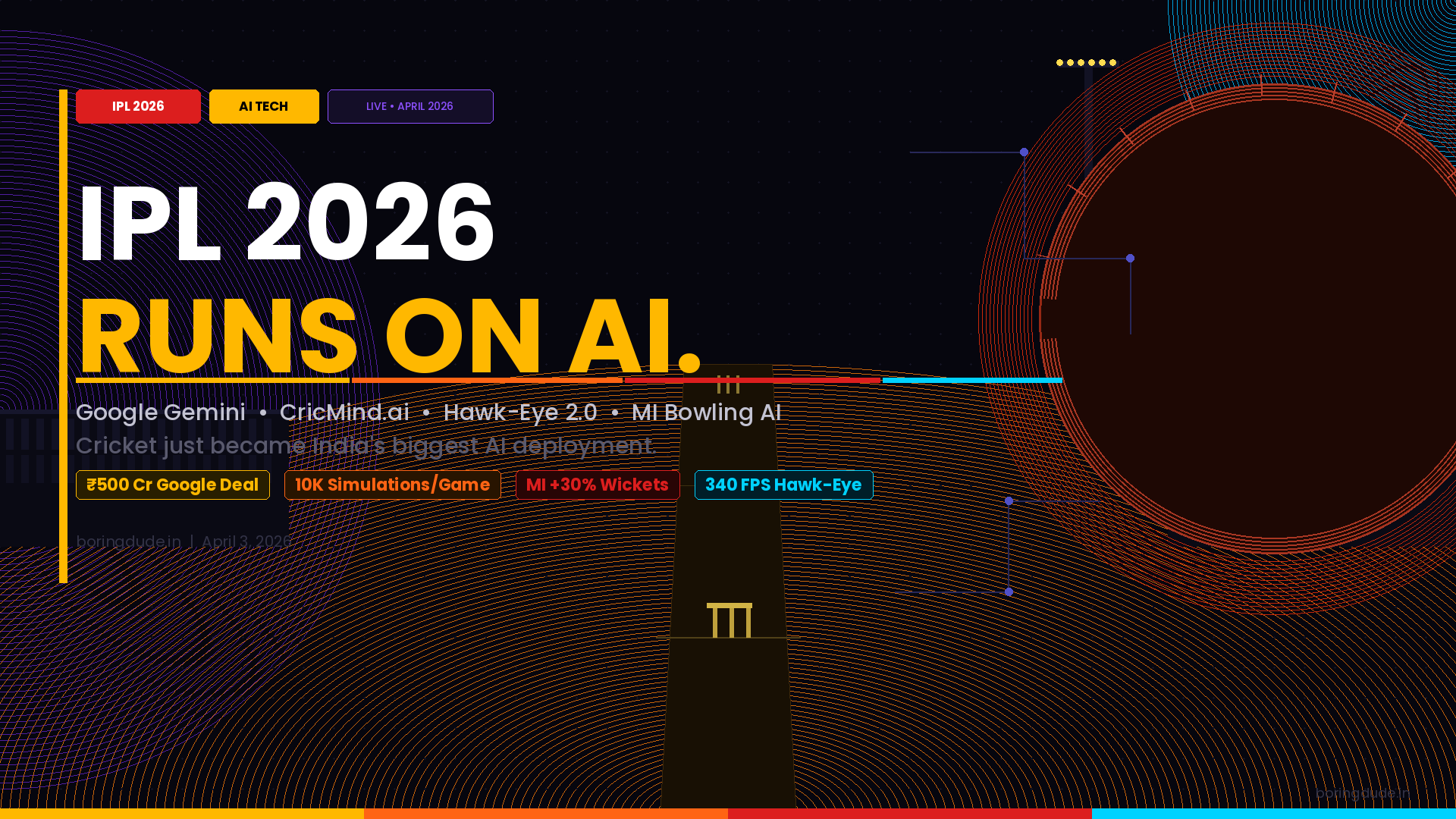
IPL 2026 Runs on AI: Google, Hawk-Eye, MI Models Explained
Read Time:8 Minute, 29 Second
IPL 2026 has over 600 million viewers watching on JioStar and Star Sports. But what most fans do not realize is that while they are watching Rohit Sharma carve one through covers or Bumrah rip out a yorker, an army of AI systems is running quietly in the background. Predicting the next delivery. Simulating the next 10,000 match outcomes. Tracking every millimeter of the ball in flight.
This is not the IPL of 5 years ago. IPL 2026 is the most AI-powered sporting event India has ever hosted. And honestly, it is one of the most AI-intensive sporting events in the world right now. Let me break down exactly what is happening behind the scenes.

Google Paid Rs 500 Crore to Make IPL 2026 Its AI Showcase
Google signed on as a premier partner of IPL 2026 in a deal worth approximately Rs 500 crore. But this is not a regular sponsorship. Google is using IPL, the most-watched cricket property on earth, as a live demonstration of its Gemini AI capabilities.
Here is what Google AI Mode actually does during IPL 2026. When you open Google Search during a match and ask “Why was that declared a no-ball?” or “What is Virat’s strike rate against left-arm pace this season?”, Gemini answers you conversationally. Real-time. With tactical context. With historical comparisons. You are not getting a static stat page. You are getting an AI-powered cricket analyst in your pocket.
The integration runs across both Star Sports television and JioStar digital. Google gets 180 seconds of ad time per match, plus deep integration into pre-match and post-match shows. The deal is a 3-year agreement with the BCCI, making Google Gemini an official tournament partner through at least the 2028 season.
For context: this is the same Gemini model that powers Google’s AI search revolution globally. Google chose IPL to introduce hundreds of millions of Indian users to AI-powered search because there is no bigger shared cultural moment in India than IPL matches. Smart strategy. The AI product and the cricket product are feeding each other.
CricMind.ai Is Running 10,000 Match Simulations Before Every Ball
CricMind.ai launched at the start of IPL 2026 as India’s first purpose-built AI cricket prediction and analytics platform. And the technology inside it is genuinely alarming.
Their core engine, called the Oracle Engine, runs 10,000 simulated versions of each match before generating a single prediction. Not 10. Not 100. Ten thousand. The output is win probability with confidence ranges, live in-match forecasting, and delivery-level predictions.
The platform also has an AI Terminal, which lets you ask natural language questions about any player or team and get statistically backed answers. Want to know what Gill’s weakness is against off-spin on a Wankhede track under lights? You can ask that. The system answers it.
There is also an “Argument Settler” feature, which I genuinely think is going to be massive for social media and friend groups. You type in a cricket debate, say “Is Bumrah the best death bowler in T20 history?” and the AI settles it with hard data. Given how seriously Indians argue about cricket, this feature alone could make the platform go viral.
Hawk-Eye Is Making Umpiring Nearly Perfect, and DRS Has Been Upgraded
Hawk-Eye is not new to cricket. But what is happening with it in IPL 2026 is significantly more advanced than what fans saw even two years ago.
Six to eight high-speed cameras are positioned around every IPL ground, each capturing 340 frames per second. The system triangulates the ball’s position in three-dimensional space and builds a complete 3D trajectory. The accuracy is approximately 2.5 millimeters. That is the width of two human hairs put together. LBW decisions that used to require judgment are now almost mathematical.
IPL 2026 expanded DRS to include two new categories. Wide-ball reviews outside the off stump, and height-based no-ball reviews. So now teams can challenge not just dismissal decisions but also decisions about whether a delivery was genuinely too wide or if a ball cleared the stumps for a no-ball. This expansion was made possible only because AI-assisted tracking became accurate enough to make these calls reliable.
The combination of AI-powered Hawk-Eye and expanded DRS means that in IPL 2026, the probability of a wrong decision surviving a review has dropped to under 2%. That is essentially cricket becoming a sport where human error in officiating is almost eliminated.
Mumbai Indians Used AI to Improve Death-Over Wickets by 30 Percent
This is the stat that made every other franchise pay attention.
Mumbai Indians ingested historical Hawk-Eye data covering years of delivery patterns for every batter in T20 cricket. Their AI model identified statistical weaknesses specific to each batter in the 17th to 20th overs. Not vague stuff like “he struggles outside off stump.” Highly specific patterns, like which batter concedes a boundary to which exact delivery type when under pressure at which phase of the innings.
The bowling rotation model then generates a recommended delivery sequence for each MI bowler against each specific batter combination. The captain and coaching staff see this in real time during the match. The result was a 30% improvement in wicket yield in death overs compared to their previous season performance.
30 percent is enormous in cricket. That is the difference between a decent bowling attack and a championship-winning one.
CSK now runs real-time mid-match simulations on every batter they face. Their system updates delivery vulnerability profiles within overs, not between matches. Meaning by the time a batter faces their fifth or sixth ball, CSK’s analytics team already has a simulation of what delivery type maximizes dismissal probability against that specific batter under those specific match conditions.
And it is not just MI and CSK. Every single IPL franchise in 2026 has a dedicated data science team running auction strategy models. When teams bid at the IPL auction, they are not bidding on reputation. They are bidding on specific data profiles: strike rate against spin in the powerplay, boundary percentage on specific ground dimensions, economy rate in T20 cricket against left-handers. The auction table now looks more like a trading floor than a cricket selection meeting.
AI Is Predicting Injuries Before Doctors Can See Them
Every IPL franchise in 2026 now equips players with wearables that feed GPS tracking data, heart rate variability measurements, and biomechanical consistency scores into AI injury prediction models. These models flag elevated injury risk before clinical symptoms appear.
This is a massive shift. Traditionally, cricketers got injured, recovered, and returned. The best teams had good physios who could manage workloads. Now AI models are looking at a bowler’s bowling load, micro changes in their run-up biomechanics, sleep and recovery data, and generating a daily readiness score. If the readiness score drops below a threshold, the AI flags the player as elevated injury risk.
In practical terms, teams are now resting bowlers in net sessions, not because the coach felt they looked tired, but because the AI model showed a 23% elevated injury probability based on the previous three days of biometric data. This is sports medicine getting a complete AI upgrade.
In IPL 2026, AI models are also now permitted to assist captains in choosing the optimal impact player substitution based on real-time weather data and live win probability metrics. The substitution decision, one of the most strategic calls in modern T20 cricket, now has an AI recommendation layer behind it.
What This Means Beyond Cricket
Here is the thing that most people covering IPL AI stories miss. The real impact is not just on cricket.
IPL 2026 is being watched by 600 million people in India. When Google Gemini powers an experience that 600 million people interact with during matches, that is a mass AI adoption event. People who have never used an AI tool in their life are now asking Gemini questions about Bumrah’s bowling stats in real time. They are experiencing conversational AI for the first time through the context of something they already love deeply.
That is how India goes from 50 million AI users to 300 million. Not through tech product launches. Through cricket.
For anyone in India working in AI, data science, sports technology, or product development, IPL 2026 is a live case study in how to deploy AI at a 600 million-person scale. The companies that built this technology, the engineers who deployed it, and the product teams that made it fan-friendly are writing the playbook for AI adoption in India.
Key Takeaways
- Google paid Rs 500 crore to make IPL 2026 a live showcase for Gemini AI, giving fans real-time conversational cricket insights.
- CricMind.ai runs 10,000 match simulations per game using their Oracle Engine for live win probability and delivery predictions.
- Hawk-Eye cameras shoot at 340 frames per second with 2.5mm accuracy, making DRS decisions nearly perfect. The DRS scope expanded in 2026.
- Mumbai Indians achieved 30% better death-over wicket yield using AI-driven bowling rotation models built on Hawk-Eye data.
- Every IPL franchise now uses AI for auction strategy, injury prediction via wearables, and real-time impact player decisions.
- IPL is functioning as India’s largest mass AI adoption event, introducing Gemini AI to hundreds of millions of fans who would not otherwise engage with AI tools.
My take. Cricket is the one thing in India that cuts across every language, every income level, every region. The fact that AI is being deployed at IPL scale means India is getting an AI education through its most beloved sport. This is not just interesting tech news. This is how India’s AI story gets written at a mass scale. Every IPL match in 2026 is a live AI deployment touching hundreds of millions of people. That is unbelievable when you think about it.
What do you think? Drop your thoughts in the comments.


Happy
0 %

Sad
0 %

Excited
0 %

Sleepy
0 %

Angry
0 %

Surprise
0 %
 0
0
 0
0

