
OpenAI GPT-5.4-Cyber: The AI That Can Reverse-Engineer Malware Without Source Code
Read Time:5 Minute, 3 Second
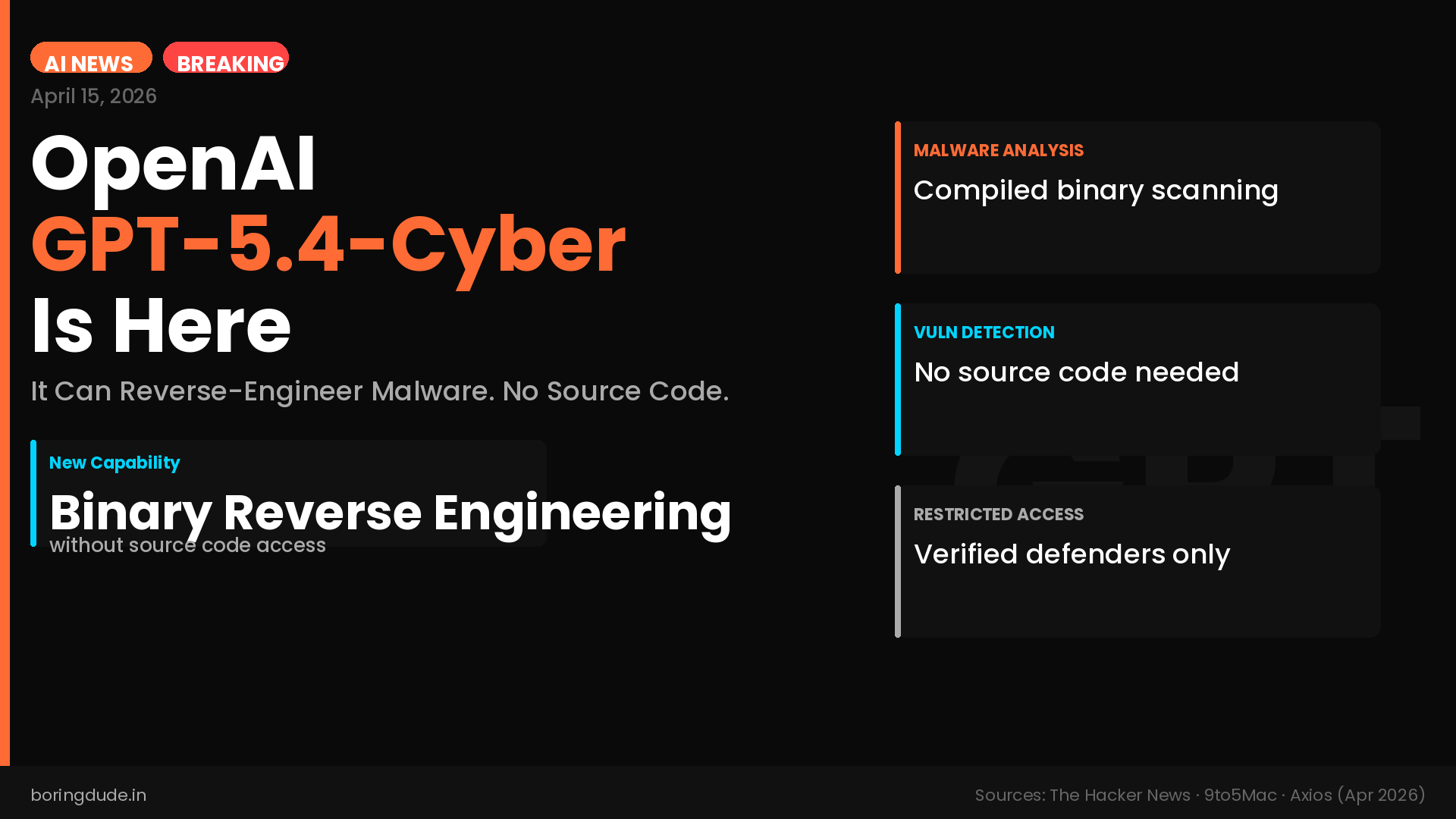
OpenAI just dropped something that most people are not talking about. On April 14 to 15, 2026, the company quietly launched GPT-5.4-Cyber. It is a specialized AI model built exclusively for defensive cybersecurity work. And one of its headline capabilities is alarming in the best possible way: it can reverse-engineer compiled malware without access to the source code.
This is not a chatbot update. This is a fundamental shift in how AI is being deployed for real-world security operations.

What Is GPT-5.4-Cyber?
GPT-5.4-Cyber is a variant of OpenAI’s flagship GPT-5.4 model, optimized specifically for defensive cybersecurity use cases. It lowers the refusal threshold for legitimate security work, meaning it will actually help you analyze malware, vulnerabilities, and security architecture in ways that the standard GPT-5.4 would decline.
The model was announced just days after rival Anthropic unveiled its own frontier model, Claude Mythos, making this a significant competitive move in the escalating AI arms race.
The Capability Everyone Is Talking About: Binary Reverse Engineering
The standout feature of GPT-5.4-Cyber is its ability to perform binary reverse engineering. In plain terms, this means the model can:
- Analyze compiled software (the final executable file, not the human-readable code)
- Identify malware signatures and malicious patterns
- Detect security vulnerabilities in the compiled binary
- Assess the security robustness of software that companies do not have source code access to
This is huge. Security professionals have long had to rely on specialized disassemblers and decompilers that require deep expertise to use. GPT-5.4-Cyber brings this capability to a conversational AI interface, dramatically lowering the skill floor for defensive security work.
Think about what this means practically: a mid-level security analyst at an Indian IT company can now analyze a suspicious vendor DLL or a flagged executable in minutes, not days.
Who Can Access It?
Access is deliberately restricted. OpenAI is not opening this to the general public. Here is how the tiered access works:
Individual Security Professionals
Verified individuals can access GPT-5.4-Cyber through chatgpt.com/cyber. You need to authenticate yourself as a legitimate cybersecurity defender. OpenAI is checking credentials and professional background before granting access.
Enterprise Teams
Enterprise organizations handling critical software security can request access through an OpenAI representative. This is aimed at companies with dedicated security operations centers, incident response teams, and vulnerability research units.
The TAC Program
GPT-5.4-Cyber is part of OpenAI’s Trusted Access for Cyber (TAC) program, which is scaling to thousands of authenticated individual defenders and hundreds of enterprise security teams. The TAC program has been quietly running as a beta with a smaller group, and this launch represents a significant expansion.
Why OpenAI Is Being This Careful
Releasing an AI that understands malware at a binary level is not something you open-source on a Tuesday. The same capabilities that help defenders detect threats can theoretically help attackers craft them.
OpenAI is threading this needle carefully. Their stated position: “As model capabilities advance, our approach is to scale cyber defense in lockstep: broadening access for legitimate defenders while continuing to strengthen safeguards.”
The dual-use concern here is real. Binary reverse engineering knowledge is not inherently dangerous, but a model that can explain exactly how a piece of malware works could be misused if it fell into the wrong hands. The tiered verification system is OpenAI’s answer to this.
What This Means for the Indian IT and Cybersecurity Industry
India is one of the largest markets for IT services and software development. Indian companies handle security operations for thousands of global enterprises. The Indian cybersecurity market is growing rapidly, and tools like GPT-5.4-Cyber have direct relevance here.
A few things to watch:
- Security teams at TCS, Infosys, HCL, and Wipro will likely evaluate TAC program enrollment for their SOC teams.
- Cybersecurity professionals with OSCP, CEH, or similar credentials are well-positioned to qualify for individual access.
- Indian IT hiring for security roles may increasingly ask for AI-augmented security experience as tools like this become standard.
- Compliance and audit teams managing vendor software risks will find binary analysis tools especially useful.
The Bigger Picture: AI Models Are Specializing
GPT-5.4-Cyber is not an isolated product decision. It is part of a broader trend. General AI models are being forked into domain-specific variants optimized for medicine, law, finance, and now cybersecurity. The era of one model doing everything adequately is giving way to specialized models doing specific things exceptionally well.
For professionals, this creates both an opportunity and a threat. If your domain gets a specialized AI model, your job gets more efficient, but so does everyone else’s. The differentiator becomes knowing how to work with the model, not just knowing the domain.
Anthropic has already moved with Claude Mythos. OpenAI responded with GPT-5.4-Cyber. Google will not be far behind. The cybersecurity AI race has officially started.
How to Get Access Right Now
- Go to chatgpt.com/cyber
- Verify your identity as a cybersecurity professional
- If you are part of an enterprise security team, contact your OpenAI account representative
- Monitor the TAC program for expanded enrollment windows
If you work in IT security, this is worth applying for now. The program is expanding, but early access will give you a real head start on understanding how to integrate this into your security workflows.
Final Thought
OpenAI launching a malware-analyzing AI model with binary reverse engineering capability is not a small product update. It is a signal that frontier AI labs are done limiting their models to safe, general-purpose tasks. Specialized, powerful, access-controlled AI is the new direction.
The question for every IT and security professional is the same one it has been for the last two years: are you learning how to use these tools, or are you waiting to see what happens?
Are you applying for TAC program access? Let us know in the comments.


Happy
0 %

Sad
0 %

Excited
0 %

Sleepy
0 %

Angry
0 %

Surprise
0 %
 0
0
 0
0

