
Indian IT Fresher Hiring Crashed 80%: The End of the IT Boom?
Read Time:6 Minute, 3 Second

Here is an alarming number: 6,00,000.
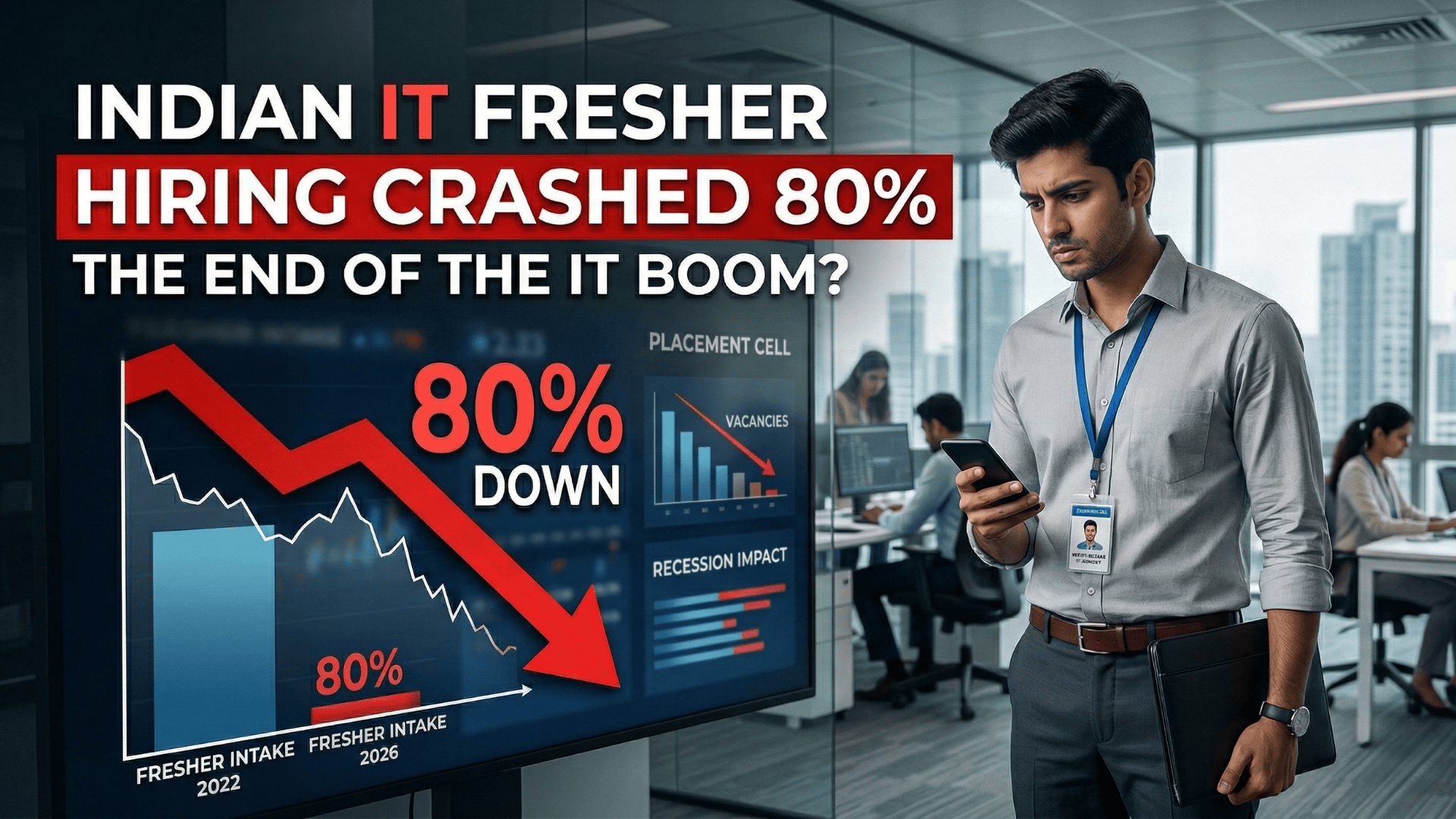
That was how many freshers Indian IT companies hired at their peak in FY22. Fast forward to FY25 and that number has collapsed to just 1,20,000. That is an 80% drop in three years. And in 2026, the situation is not recovering. It is getting worse.
At the same time, 55,911 tech workers globally have already lost their jobs in just the first three months of 2026. Across 171 companies. That is 736 people per day being handed pink slips. Every single day.
This is not a temporary slowdown. This is a structural transformation. And if you are a fresher trying to break into IT, or a working professional who thinks the storm will pass, you need to read this carefully.

What Is Happening Right Now
A BusinessToday report published on March 21, 2026, confirmed what many in the industry already suspected: India’s fresher IT hiring is not in a cyclical dip. It is in a permanent transformation. The traditional model of Indian IT companies hiring tens of thousands of fresh graduates, training them for months, and deploying them on client projects is breaking down faster than anyone anticipated.
Here is what the major companies are doing right now in 2026:
- TCS cut nearly 20,000 jobs in the second half of 2025. The biggest layoff in the company’s history. An AI-driven overhaul was the stated reason.
- Wipro reduced its fresher hiring guidance from 10,000 to just 7,500 to 8,000 this fiscal year and has only onboarded about 5,000 so far.
- Tech Mahindra is hiring fewer freshers in FY26, redirecting focus toward redeploying existing talent freed up by AI automation projects.
- Infosys is holding steady at a target of 20,000 fresher hires, making it one of the few large firms maintaining relative stability.
The global picture is just as alarming. Block, the payments company run by Jack Dorsey, announced 4,000 job cuts in early 2026. That is 40% of the company’s entire workforce. Dorsey explicitly named AI as the reason. Atlassian cut 10% of its workforce to redirect investment toward AI products. Amazon announced 16,000 cuts across AWS, retail, and advertising teams.
In 2026, virtually every major company announcing layoffs is explicitly naming AI as the driver. Not recession. Not market slowdown. AI. This is a different kind of disruption.

Why This Matters for Every Indian IT Professional
If you are a fresher waiting for your offer letter to convert to a joining date, or a 2022 to 2023 pass-out who is still on the bench, this directly affects you. Here is why the situation is more serious than most people are acknowledging:
- The bench model is collapsing. Companies used to hire large batches of freshers, train them, and bill them to clients. AI tools now do a large part of what those freshers were trained to do. Basic code generation, software testing, customer support triage are all getting automated.
- Entry-level openings are drying up. AI chatbots now resolve 70 to 80% of customer support queries at companies like Block, eBay, and Pinterest without any human involvement. Basic QA and software testing roles have shrunk sharply as AI tools automatically generate and run test suites.
- The hiring requirement has changed. Companies are not asking for your percentage or your college name in the shortlisting process anymore. They are asking for demonstrated capability with AI tools, cloud platforms, and niche specializations.
- Overall tech hiring in India was down 24% year-over-year as of January 2026 according to a Xpheno report. January is normally a strong hiring month. That signal is hard to ignore.
What You Need to Do Right Now
The situation is alarming. But it is not hopeless. The industry is transforming, not disappearing. Here is what every Indian fresher and working professional should be actively doing today:
- Learn at least one AI tool deeply, not just surface-level. Not just using ChatGPT to write emails. Actually build with AI APIs. Use GitHub Copilot or Cursor on a real project. Companies are hiring people who can multiply productivity with AI, not people who just mention it on a resume.
- Shift from generalist to specialist. The era of calling yourself full-stack when you know a bit of everything is over for freshers. Pick one niche: AI engineering, cloud infrastructure, cybersecurity, data engineering, or prompt engineering. Go deep. Build projects that prove it.
- Certifications now carry more weight than college names. AWS, Google Cloud, and Microsoft Azure certifications are actively looked for in shortlisting. Nasscom and NIIT are running AI-specific programs that companies are hiring from directly. Start one this week, not next month.
- Expand your search beyond the Big 5 IT services firms. Tier-2 city hiring rose 30% year-over-year even as metro hiring fell. Product companies and funded startups are still growing their engineering teams. Limiting your job search to TCS, Infosys, Wipro, HCL, and Tech Mahindra is a mistake in 2026.
- Build a public portfolio now. LinkedIn, GitHub, and even YouTube are replacing resumes for tech hiring in 2026. If you build something with AI, share it publicly. Hiring managers are searching your name before they call you.

The Bigger Picture
AI jobs across the industry are growing 92%. The wage premium for AI-specialized roles is 56% higher than equivalent non-AI positions. The jobs are not disappearing entirely. They are transforming. The companies cutting thousands of generalist roles are simultaneously building smaller, higher-paid teams of AI-fluent specialists.
This shift is happening faster than any previous technology wave. The window to adapt is shorter than people think. Companies are not waiting for freshers to catch up. They are moving forward with whoever is ready today.
My Take
I have been saying this for two years and I will say it one more time: no job is safe if you are not adapting. The 80% drop in fresher hiring is not TCS being evil or Wipro being unreasonable. It is companies responding to a market where one AI-fluent engineer can do what five generalist freshers used to do. That is the reality of 2026.
The opportunity still exists. India will still need tech talent. But it will need skilled, AI-fluent, specialized talent. Not mass-hired bench-sitters waiting to be deployed on legacy projects.
If you are a fresher reading this and still waiting for the old market to return, stop waiting. The old market is not coming back. Start building the skills that matter today. The window is open right now. Do not let it close on you.
What do you think about this shift? Are you already adapting or still waiting for the hiring boom to return? Comment below. And follow me for daily updates on tech, AI, and careers that actually matter.


Happy
0 %

Sad
0 %

Excited
0 %

Sleepy
0 %

Angry
0 %

Surprise
0 %
 0
0
 0
0

