
Claude Fable 5 Is Here. Anthropic Just Released Its Most Powerful Model Ever.
Read Time:7 Minute, 35 Second
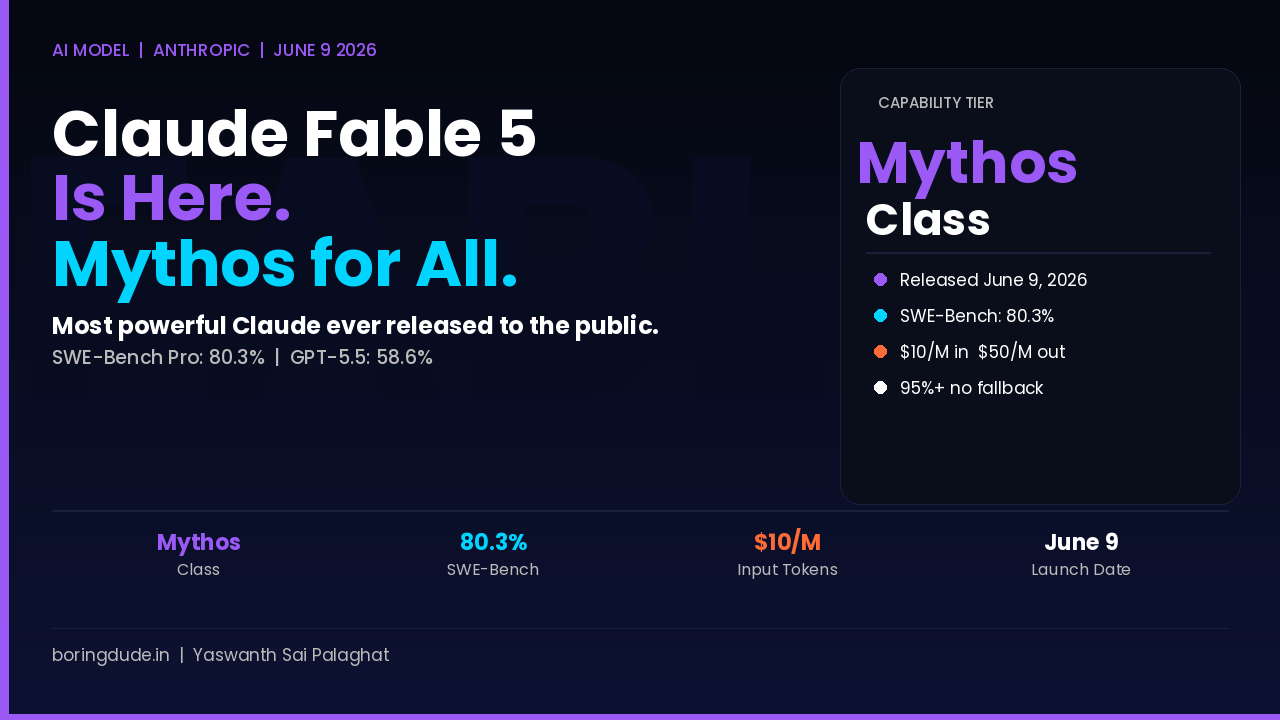
Anthropic just released the most capable AI model it has ever made available to the public. Claude Fable 5 launched on June 9, 2026, and it is not an incremental upgrade. It is a Mythos-class model. The tier that sits above Opus. Made safe enough for general use. And what it can do is genuinely different from anything that has come before it.
If you have been watching the AI race and wondering when a model would cross a line that felt qualitatively new, this is that moment. Here is everything you need to know.
What Is Claude Fable 5
Claude Fable 5 is a Mythos-class model. Until today, Mythos-class models were restricted to a small group of cybersecurity defenders and infrastructure providers through Project Glasswing, Anthropic’s government-partnered security initiative. The reason they were restricted: the capabilities were so powerful that Anthropic was not confident it could prevent misuse at general release.
That changes today. Anthropic says it has built safeguards strong enough to release Fable 5 broadly. There is a key distinction, though. When queries touch cybersecurity exploitation, biology research, or distillation attempts, the model automatically falls back to Claude Opus 4.8. Everything else runs on full Fable 5 capability. And according to Anthropic’s data, more than 95 percent of sessions never trigger the fallback at all.
The name is intentional. Fable is from the Latin fabula, meaning “that which is told,” related to the Greek mythos. The safeguards are what separate Fable from Mythos 5, which is the same underlying model with some restrictions lifted, available only to trusted partners.
What Claude Fable 5 Can Actually Do
Anthropic says Fable 5’s capabilities exceed those of any model it has ever made generally available. It is state-of-the-art on nearly every benchmark tested. But benchmarks are only part of the story. The real picture is in what Fable 5 is doing in production for early customers.
Stripe ran Fable 5 on a 50-million-line Ruby codebase and performed a complete codebase-wide migration in a single day. Stripe’s own estimate: that task would have taken a whole team more than two months by hand. The model compressed months of engineering work into 24 hours.
On SWE-Bench Pro, which tests real software engineering capability, Fable 5 scored 80.3 percent. GPT-5.5 scored 58.6 percent. That is not a close race.
Cursor’s CEO said Fable 5 is state-of-the-art on CursorBench and “opened up a class of long-horizon problems that were out of reach for earlier models.” GitHub’s Chief Product Officer said it took on complex, long-horizon coding tasks with a level of autonomy and reliability that exceeded previous benchmarks. Cognition’s CEO said Fable 5 is the highest-scoring model on FrontierBench, their frontier coding evaluation.
These are not vague endorsements. These are specific capability claims from companies that benchmark AI models daily as part of their business.
Vision: Pokemon, CAD, and Web Apps from Screenshots
One of the more striking demonstrations of Fable 5’s vision capabilities is that it completed Pokémon FireRed from start to finish using only raw game screenshots. No maps, no navigation aids, no extra game-state information. Earlier Claude models needed a complex helper harness to play Pokémon. Fable 5 finished the game with vision alone.
Beyond games, Fable 5 can extract precise numbers from detailed scientific figures, rebuild web app source code from screenshots, and design complete 3D-printable models in a browser-based CAD editor. The CAD editor used in the demo was also built by Fable 5 itself, including the built-in AI copilot that does the modeling.
Knowledge Work and Long Context
Hebbia’s Finance Benchmark, which tests senior-level reasoning on complex financial documents, shows Fable 5 as the highest-scoring model of any tested. IMC, a trading firm, said Fable 5 excelled their trading-analysis evaluations across the board, including factual lookup, conceptual reasoning, root-cause analysis, and expected-value analysis.
On long-context tasks, Fable 5 stays focused across millions of tokens and improves its outputs using its own notes. The model played Slay the Spire, the deck-building game, with access to persistent file-based memory. That memory improved its performance three times more than it improved Opus 4.8. Fable also reached the game’s final act three times more often.
A frontier physics researcher, Matthew Pines of the Newton Institute, reported that GPT-5.5 took four days on a complex task. Fable 5 got to nearly the same result in 36 hours, using a third of the reasoning tokens.
Drug Design and Scientific Research
This is where Claude Mythos 5, the restricted version of the same underlying model, is producing the most significant results. Using Mythos 5, Anthropic’s internal protein design experts accelerated aspects of the drug design process by around ten times. In one case, Mythos 5 with protein design and bioinformatics tools but no human assistance matched or beat skilled human operators at choosing binding sites, selecting and running protein design tools, and recovering from failures.
Nine of 14 protein targets from that study yielded strong drug design candidates currently under investigation.
Separately, Mythos 5 conducted novel genomics research over the course of a week of largely autonomous work. It assembled single-cell data for millions of cells spanning 138 animal species, designed and trained a custom machine learning model, and outperformed a recent model published in Science. It did this despite being 100 times smaller.
These are not proof-of-concept demos. These are production research results.
The Safety Architecture Behind Fable 5
What makes the general release possible is a new set of classifiers. These are separate AI systems that run alongside Fable 5 and detect potential misuse. When a query is flagged for cybersecurity exploitation, biology and chemistry research, or distillation attempts, Fable 5 automatically falls back to Opus 4.8 instead. Users are informed when this happens.
Anthropic red-teamed the classifiers extensively. An external bug bounty produced no universal jailbreaks after more than 1,000 hours of testing. The UK AISI made early progress toward one in an initial testing window, but Anthropic says any remaining jailbreaks need to be slow and costly enough to detect before they scale.
The cybersecurity fallback specifically covers exploitation and offensive cyber tasks. On tests where Fable 5’s responses are blocked rather than falling back, the model makes no progress on agentic hacking tasks. For the 95-plus percent of sessions that never touch these areas, Fable 5 performance is effectively identical to Mythos 5.
Pricing and Availability
Claude Fable 5 is available today on the Claude API and through Amazon Bedrock. The model string is claude-fable-5. Pricing is $10 per million input tokens and $50 per million output tokens. That is double Opus 4.8’s rate but less than half the price of Claude Mythos Preview.
For subscription users: Fable 5 is included at no extra cost on Pro, Max, Team, and Enterprise plans from today through June 22, 2026. On June 23, it shifts to usage credits. Anthropic has said it intends to restore Fable 5 as a standard part of subscription plans as capacity allows, and will communicate changes ahead of time.
Claude Fable 5 is also live on GitHub Copilot and Databricks, with more integrations expected in the coming weeks.
What Fable 5 Means for the AI Race
The practical significance of this release is that the frontier of AI capability just moved into the hands of anyone with a Claude subscription or API key. Three months ago, Mythos-class capability was accessible only to government-vetted cybersecurity organizations. Today, it is accessible to a developer in Hyderabad running Claude-fable-5 on a personal project.
For developers and knowledge workers, the implication is direct: tasks that previously required teams can now be attempted by individuals. Long-horizon autonomous coding, complex research synthesis, vision-based analysis, and drug design acceleration. These are no longer lab demonstrations. They are production capabilities with pricing attached.
The gap between Claude Fable 5 and its nearest competitor on software engineering benchmarks is 21 percentage points. In a space where model differences are usually measured in single digits, that is a significant lead. How long it holds is the only real question.
What Comes Next
Anthropic has also launched Claude Mythos 5 alongside Fable 5 today. It is the same underlying model with cyber safeguards lifted, available only to Glasswing partners. A broader trusted access program for cybersecurity organizations is planned, along with a separate trusted access program for biology researchers to access Fable 5 with biology safeguards removed.
The implication is clear: today’s general release is not the ceiling. It is the floor that Anthropic decided was safe enough to open. The full Mythos 5 running without restrictions is already deployed for a small group of users who have demonstrated they will use it responsibly.
The frontier just became accessible. What developers and researchers build on top of it in the next 90 days is going to be worth watching closely.


Happy
0 %

Sad
0 %

Excited
0 %

Sleepy
0 %

Angry
0 %

Surprise
0 %
 0
0
 0
0

