
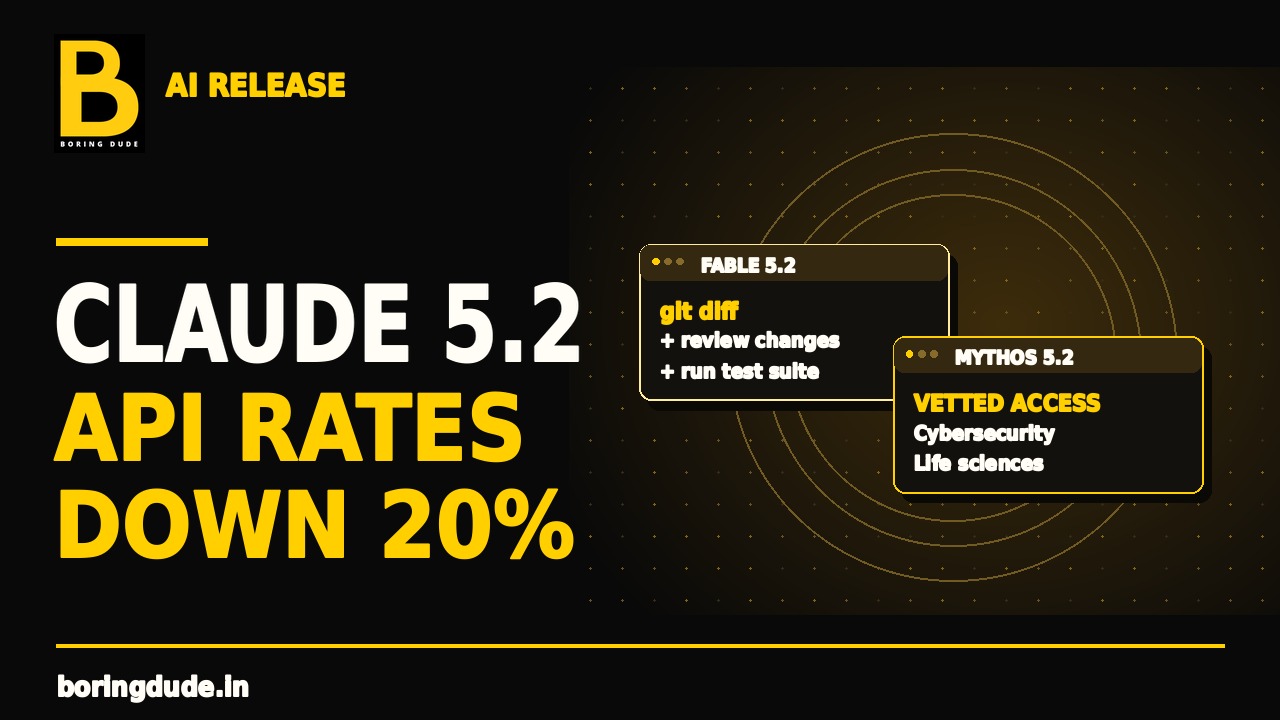
Anthropic Cuts Claude Fable and Mythos API Rates by 20% With 5.2 Launch
Read Time:5 Minute, 35 Second
Anthropic released Claude Fable 5.2 and Claude Mythos 5.2 on November 9 in the United States, early November 10 in India. Both models cost 20% less per token than their 5.1 predecessors at standard API rates. They share an underlying model, but Anthropic has opened Fable to a broad audience and kept Mythos behind an approval process for cybersecurity and life sciences work.
The change gives software teams a cheaper way to try Anthropic’s high-end model on work such as upgrading an old codebase. It also keeps two decisions separate for buyers. One is whether the new rates make a project affordable. The other is whether the team can use the version with the permissions it needs. Anthropic’s launch announcement explains the access split, and Reuters confirmed the launch and standard prices.
What Anthropic changed in Claude 5.2
| What changed | What users get |
|---|---|
| Standard API pricing | $8 per million input tokens and $40 per million output tokens, down from $10 and $50. |
| Optional fast mode | $16 per million input tokens and $80 per million output tokens. Anthropic says it can generate tokens up to 2.5 times as fast as standard mode. |
| Fable 5.2 access | Broad access with safeguards for sensitive cybersecurity and biology requests. |
| Mythos 5.2 access | Restricted to approved cybersecurity and life sciences users through verification programs. |
A token is a unit of text or code processed by the model. Input includes material a team sends, such as a prompt or a file. Output is what the model generates in response. For an API workload that consumes one million input tokens and 200,000 output tokens, the standard model charges would come to $16 on 5.2, compared with $20 on 5.1, before any separate charges or discounts. The calculation uses the rates reported by Computerworld.
That example holds token use constant. In a real migration, an agent might read more files, retry a failed build or ask another agent to review its work. Those steps can change the number of tokens used. Teams looking at a lower rate will still need to check the cost of a completed task. The price comparison also concerns the API. It does not establish a price change for a Claude subscription.
What the coding results say about Fable
Anthropic reported that Fable 5.2 scored 49.1% on FrontierCode 2.0 at its highest effort setting, up from 32.4% for Fable 5.1 at its highest effort setting. The test asks whether changes generated for open-source projects meet the standards of maintainers. The difference is 16.7 percentage points on that test. These are Anthropic’s published evaluation results, and the score will not tell a team how many of its own pull requests will pass review.
Anthropic also said the new models can generate output up to 30% faster than their predecessors. Faster generation measures one part of the job. A coding agent can also spend time waiting for tests, reading logs or running tools. A shorter response time can matter for a developer waiting on a review, while a slow build may still dominate the elapsed time on a larger migration.
A migration has more than one owner
For a team replacing an old library, the model can propose edits across several packages and surface failures. The maintainers still need to establish what counts as finished. Passing tests might be enough for one package, while another could require a performance comparison and review of downstream dependencies. A release owner also needs to know how to reverse the change if a later deployment fails.
For an engineering team in India serving an overseas client, there may be a further approval step before the model can see the client’s repository. The launch gives that team a new option to evaluate. Which files it can share depends on the client agreement and the service configuration. For background on the product line, see BoringDude’s coverage of the original Claude Fable 5 release.
Why Mythos access stays restricted
Anthropic says Fable and Mythos use the same underlying model. The difference is how users can access sensitive capabilities. Fable has safeguards that block many cybersecurity and biology requests. Anthropic allows approved researchers and defenders to seek Mythos access through its cybersecurity and life sciences verification programs. A developer who can already use Fable should not assume that the same account can call Mythos.
That distinction matters for security teams. A software maintainer might use Fable for routine refactoring, while a specialist trying to reproduce a suspected flaw could need tools that Fable restricts. The release gives approved teams a new version to test. Whether they can use it on a particular system still depends on the authority they have to test that system and the data they are allowed to send. BoringDude’s coverage of Australia’s proposed AI incident reporting rules explains why those permissions can matter when an agent uses external tools.
What teams can verify next
The API rates and access split are public. The size of the saving on a real project is still an open question. A useful comparison would run both versions on the same set of issues, with the same files and review criteria. The person approving the spend can then compare the cost of changes that pass review, including work the model has to redo. The team responsible for security can track which requests were blocked and whether those requests were part of legitimate work.
There is also a difference between a launch announcement and approval for a particular organisation. An eligible security or research team can apply for Mythos, but the announcement gives no approval date for any new applicant. That leaves teams with two timelines to plan around: when they can run a controlled test and when they can move approved work into a live project.
Frequently asked questions
How much does Claude Fable 5.2 cost on the API?
Standard pricing is $8 per million input tokens and $40 per million output tokens. Optional fast mode costs $16 and $80 respectively.
How much did Anthropic cut standard API rates?
Both the input and output rates fell by 20% from the previous Fable and Mythos versions. Input went from $10 to $8 and output from $50 to $40 per million tokens.
Who can use Claude Mythos 5.2?
Anthropic restricts Mythos access to approved users in its cybersecurity and life sciences verification programs. Fable 5.2 is available more broadly with additional safeguards.
When did Claude Fable 5.2 and Mythos 5.2 launch?
Anthropic dated the announcement November 9, 2026 in the United States. It was already November 10 in India when the release was reported.


Happy
0 %

Sad
0 %

Excited
0 %

Sleepy
0 %

Angry
0 %

Surprise
0 %
 0
 0


Average Rating