
Only 16% of Americans Think AI Will Benefit Society. The Numbers Tell a Brutal Story.
Read Time:6 Minute, 27 Second
Half of America is using AI. Only 16 percent of America thinks it will end well. That gap is one of the most important numbers in tech right now, and a new Pew Research study published this week makes it impossible to ignore.
The study asked Americans how they feel about artificial intelligence, how much they use it, and how much they trust the companies and governments building it. The answers reveal something the industry does not like to talk about: adoption is climbing fast, but trust is not following.
The Main Number: 16 Percent
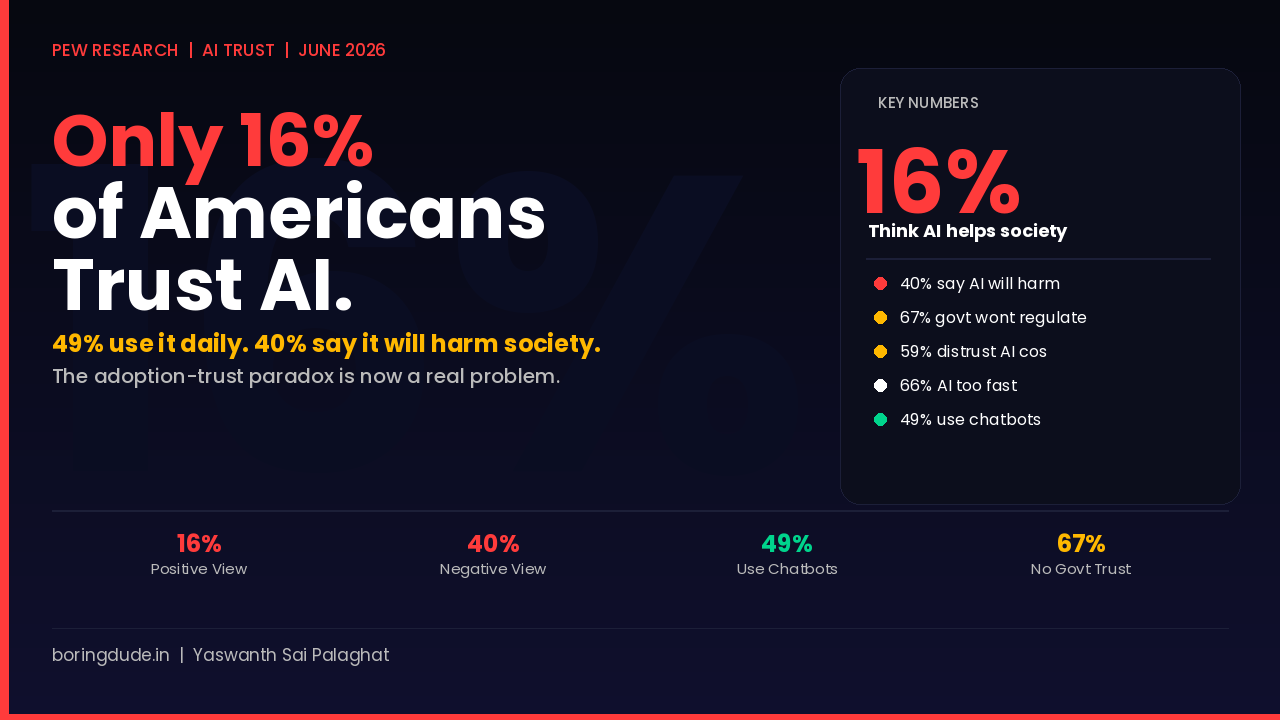
Only 16 percent of Americans believe that AI will have a positive impact on society over the next 20 years. That is the headline finding from Pew Research’s June 2026 study, and it is a striking number given the scale of investment, the number of headlines, and the volume of optimism coming out of Silicon Valley every week.
The breakdown is stark. Around 40 percent of Americans expect AI to have a negative impact on society. About one-third expect a mix of positive and negative outcomes. The truly optimistic group, the 16 percent, is smaller than the group that does not yet use AI chatbots at all.
For context: Anthropic just filed for an IPO at a $965 billion valuation. OpenAI is valued at $852 billion. The AI industry is telling a story about transformational positive impact. Most Americans are not buying it.
Who Is Using AI and How Often
The skepticism does not mean people are staying away from the technology. Pew found that 49 percent of US adults now use AI chatbots, up from 33 percent two years ago. Around one in four Americans uses a chatbot daily. The numbers show that AI has crossed from early adopter territory into mainstream use.
ChatGPT is the dominant tool. Forty-four percent of US adults say they use OpenAI’s chatbot. The next most used tools: Gemini at 24 percent, Copilot at 17 percent, and Meta AI at 14 percent. Claude sits at 6 percent, Grok at 8 percent, and Character.ai at 3 percent.
The purposes people use chatbots for are mostly practical. Research, work tasks, and information lookups dominate usage. Six in ten survey respondents said they routinely read AI-generated summaries on the internet, which on Google Search are essentially unavoidable now.
The Trust Gap Is the Actual Story
The numbers around trust are where the study gets genuinely alarming for the industry.
Sixty-seven percent of Americans do not believe the US government will do anything to meaningfully regulate AI. That is not a fringe view. Two out of three Americans have already concluded that regulators are not going to keep up.
Fifty-nine percent do not trust companies to develop AI safely. More than half of the country has looked at the AI industry and decided that the companies building these systems cannot be relied upon to do it responsibly.
And sixty-six percent, nearly two-thirds, think AI is developing too quickly. Not at the right pace. Not slower than they would like. Too fast.
When you combine these numbers, what you get is a public that is using a technology it fundamentally does not trust, built by companies it does not believe are being careful, and overseen by a government it does not expect to act. That is an unusual situation for any major technology at the height of its investment cycle.
Young People Are the Most Negative
The AI industry often points to younger users as evidence that the technology will be embraced generationally. The Pew data complicates that narrative.
Only 14 percent of Americans under 30 believe AI will have a positive impact on society. That is lower than the already low overall figure of 16 percent. The generation that grew up with social media, that watched platforms optimize for engagement over wellbeing, that lived through the algorithmic attention economy, is more skeptical of AI than their parents are.
This is not a cohort that has not been exposed to AI. Under-50 Americans are more likely than any other age group to use AI chatbots. They are using the tools and still not buying the optimistic story.
The Gender Divide
Men use AI more than women and are more enthusiastic about it. Twenty-seven percent of men use AI chatbots daily compared to 20 percent of women. Men are also more likely than women to use multiple AI products beyond ChatGPT, including Copilot and Grok.
Women are more skeptical. They report lower enthusiasm for the technology and lower confidence that it will produce good outcomes. The pattern is consistent with what has been observed in previous Pew research on emerging technology attitudes.
Half the Country Is Still Not Using AI
Despite the 49 percent adoption figure, roughly half of Americans still say they do not use AI in their daily lives. Among Americans aged 65 and older, that figure rises to 75 percent. Three out of four seniors are not using AI chatbots, and most say they have no intention of starting.
The people who do not use AI give a consistent reason: they are not interested, and they do not plan to become interested. This is not a group waiting to be converted by better UX or lower prices. They have made a choice.
What the Industry Is Selling vs. What People Are Seeing
The central tension in this data is between two realities that exist at the same time. The AI industry is in the middle of an investment super-cycle, with trillion-dollar valuations, record IPOs, and daily announcements about models that can write code, design drugs, and compress months of work into hours. And simultaneously, the people using those tools, in their daily lives and at work, have broadly concluded that this technology is more likely to harm society than help it.
That disconnect matters for a few reasons. Public trust shapes regulation. An industry operating with low public trust is more likely to attract aggressive regulatory attention, especially when two-thirds of people believe development is moving too fast. It also shapes workforce dynamics. Workers who distrust AI are less likely to adopt it enthusiastically, which affects how quickly productivity gains materialize.
For Indian professionals, this is worth paying attention to. The Indian IT industry is being reshaped by AI faster than almost any other sector, with companies cutting headcount in traditional roles while investing in AI-capable talent. The question of whether AI ultimately helps or harms is not abstract here. It is playing out in hiring decisions, project pipelines, and career planning right now.
The Adoption-Trust Paradox
Perhaps the most interesting insight from the Pew study is that adoption and trust are not the same thing, and they do not necessarily move together. People are using AI because it is useful, not because they believe in it. They are using ChatGPT to research things, draft emails, and answer questions, while simultaneously telling pollsters that they think the technology will have a negative impact on society over the next two decades.
This is not irrational behavior. People use tools that are useful to them all the time while holding skeptical views about the institutions that make those tools. Social media adoption followed a similar pattern.
The question for the AI industry is whether it wants to close the trust gap or continue to grow despite it. The Pew numbers suggest it has been choosing the latter. What happens when 40 percent of the population believes the technology is bad for society and that belief starts to shape votes, regulations, and corporate policy, is the scenario that neither Silicon Valley nor its investors have fully priced in.


2025 batch hiring accenture accenture hiring accenture hiring 2024 accenture hiring 2024 batch AI AI jobs India AI news AI tools AI Training AI training jobs amazon amazon jobs amazon work from home amazon work from home job amazon work from home jobs analyst artificial intelligence Automation bangalore barclays career career development chatgpt coding cognizant cognizant campus hiring cognizant hiring cognizant jobs cognizant jobs for freshers cognizant off campus hiring deloitte deloitte hiring freshers deloitte hiring process digital marketing earn money online India engineers Freelance Jobs India Fresher Hiring fresher jobs fresher jobs 2026 freshers freshers hiring freshers hiring for 2025 batch freshers jobs genpact genpact hiring genpact hiring process genpact interview genpact jobs genpact jobs for freshers genpact process associate google Hiring Hyderabad infosys infosys hiring intern interns Internships Jobs jobs for freshers laptops latest hiring machine learning mass hiring 2025 batch off campus drive off campus hiring openai oracle Process associate programming prompt engineering remote jobs Remote Jobs India remote work software Developer Software engineer software engineering software engineer jobs TCS tech layoffs technology tech support wipro wipro hiring wipro hiring 2025 wipro hiring freshers wipro hiring freshers 2024 work from home work from home 2026 Work From Home India work from home India 2026 work from home job work from home jobs work from home jobs 2023 work from home jobs 2024 work from home jobs for women work from home jobs india work from home jobs no experience


Happy
0 %

Sad
0 %

Excited
0 %

Sleepy
0 %

Angry
0 %

Surprise
0 %
 0
0
 0
0

