
Your Peace Sign Selfie Is a Security Risk. AI Can Now Steal Your Fingerprint From Selfies.
Read Time:8 Minute, 20 Second

You take a selfie. Two fingers up — the classic peace sign. You post it online. Within minutes, someone with the right AI tool and a high-resolution screen can extract your fingerprints from that single photo. And unlike a stolen password, you cannot change your fingerprints. Ever.
This is not a theoretical future threat. It is happening right now, and Chinese security researchers demonstrated exactly how it works on national television in April 2026.
What Happened on the TV Show
The warning went viral after a mainland Chinese workplace reality show aired footage of financial expert Li Chang demonstrating fingerprint extraction live on camera. Using a celebrity’s publicly available selfie, Li showed how clearly visible finger ridges become when a V-sign or peace sign photo is taken at close range and then enhanced using photo editing software and AI tools.
The demonstration was not theoretical. The fingerprint ridges became readable on screen after image enhancement — the same kind of AI-powered sharpening technology that is available in free apps and consumer software today.
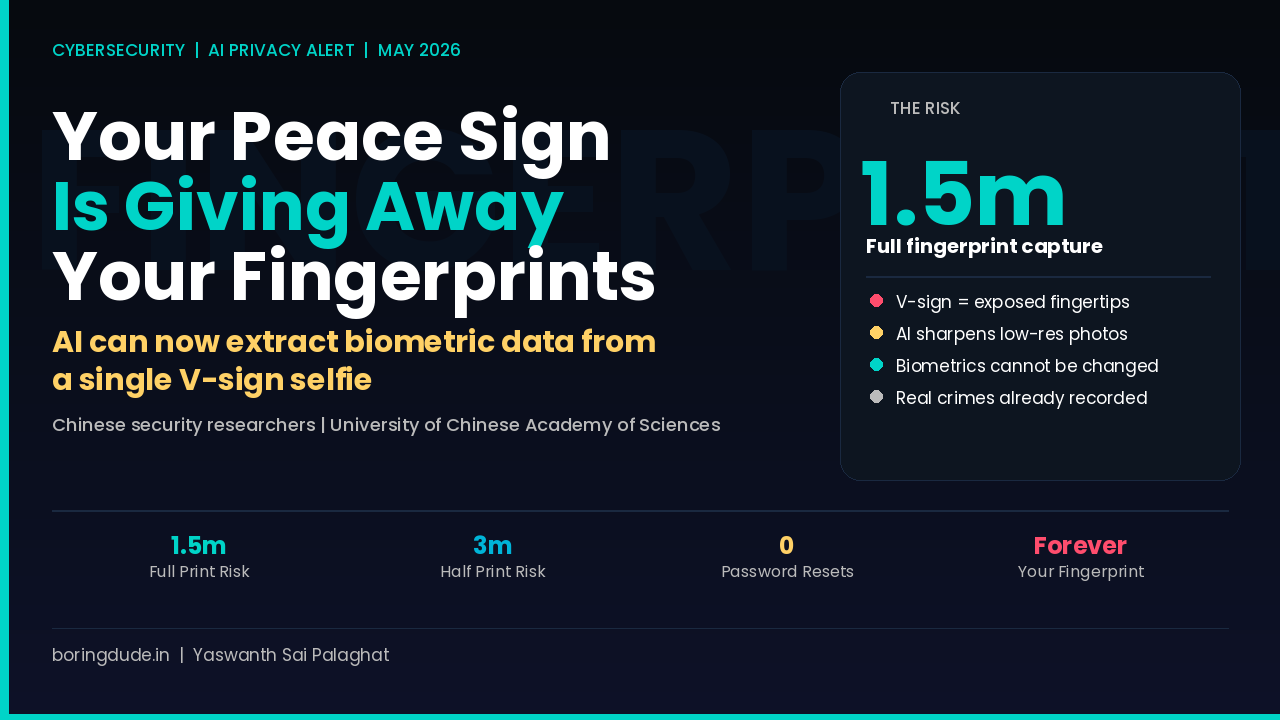
Li Chang laid out the risk parameters clearly. If a person’s fingertips directly face the camera and the photo is taken within about 1.5 meters, there is a high probability that fingerprint ridges can be captured with enough detail for reconstruction. Even at distances between 1.5 and 3 meters, around half of the fingerprint detail can still be recovered. Modern smartphone cameras — many shooting at 50 megapixels or more — make this significantly easier than it was five years ago.
The Science Behind It
Jing Jiwu, a cryptography professor at the University of Chinese Academy of Sciences, confirmed the technical basis of the warning. He said that portrait photos taken with high-quality cameras can make it possible to reconstruct detailed hand structure from a V-sign or “scissor hand” pose.
The professor was careful to note that actual fingerprint reconstruction requires several conditions to align — lighting, focus, image resolution, and the shooting angle all affect whether enough data is captured. But critically, he noted that the risk increases significantly when criminals obtain multiple images of the same person from different angles, or when photos are taken with higher-resolution devices.
Pei Zhiyoung, director of the Qianxin Industry Security Research Centre, added a key nuance: the risk is not uniform across all selfies. But when those conditions do align — and with modern cameras and AI tools, they align more often than most people assume — the threat is real.
The process works because fingerprint ridges are physical structures on your skin. A high-resolution photograph taken at close range captures those structures in enough detail for AI image enhancement tools to amplify and reconstruct them. Once reconstructed, a fingerprint pattern can theoretically be transferred to a silicone or gelatin prosthetic and used to spoof fingerprint sensors.
This Is Not New. AI Just Made It Easier.
The idea that fingerprints can be stolen from photographs has been around for over a decade. In 2014, German hacker Jan Krissler caused significant concern when he demonstrated that he could digitally reproduce a German politician’s fingerprints using publicly available photos. At the time, it required specialized hardware and expertise.
What changed is AI. The same image enhancement and reconstruction techniques that Krissler needed specialist tools to achieve in 2014 are now accessible through consumer-grade software and AI photo enhancement apps. The barrier to fingerprint theft from photos has dropped substantially — not because the concept is new, but because the tools are now widely available and easy to use.
The AI tools currently used for malicious fingerprint reconstruction are the same category of tools marketed for photo enhancement and face restoration. They are not exotic or hard to find. This is what makes the 2026 warning significantly more urgent than the 2014 precedent.
Real Crimes Have Already Happened
This is not purely theoretical. In 2025, a group of criminals in Hangzhou, Zhejiang province, China, reportedly attempted to unlock a homeowner’s smart door lock using a hand photograph the owner had previously posted online. The case demonstrated that fingerprint extraction from social media photos has already crossed from theoretical vulnerability to active criminal technique.
In South Korea, a group was caught in 2021 attempting to transfer real estate under another person’s name using fake fingerprints made from silicone. Employees at some public institutions have also been caught manipulating attendance records using forged fingerprints manufactured from stolen biometric data.
The pattern across these cases is consistent: criminals obtain a photograph, extract fingerprint detail, manufacture a physical replica, and use it to spoof a sensor. Every step of that process has gotten easier as camera quality has improved and AI tools have proliferated.
Why Fingerprint Theft Is Especially Dangerous
The unique danger of fingerprint data is irreversibility. If a password is stolen, you change it. If a credit card is compromised, you cancel it and get a new one. If your fingerprint data is extracted and replicated, you cannot update it. Your fingerprints are yours for life.
This makes biometric data theft fundamentally different from every other form of identity compromise. The consequences can follow a person indefinitely — across every device, app, door lock, and payment system that uses their fingerprints for authentication.
Fingerprints are used today to unlock smartphones, authorize payments, verify identity at border crossings, access offices, and sign into financial applications. A successfully replicated fingerprint can potentially be used across all of these systems. The attack surface is large and growing as biometric authentication becomes more common.
The Poses That Create Risk
Security experts have identified specific hand positions that increase exposure. The V-sign or peace sign is the most commonly cited — the two-finger pose that directly faces the fingertips toward the camera. The Korean heart sign, which also displays the tips of the index finger and thumb at close range, has been flagged for similar reasons, particularly given its popularity in K-pop fan culture.
The risk is significantly lower when the photo is taken from more than 3 meters away, the fingertips are not directly facing the camera, the image is compressed or low resolution, fingers are partially curled or blurred, or the hand is moving during the shot.
The risk is significantly higher when the photo is taken close-up with a high-resolution camera, the fingertips face the lens directly, the image is posted in full resolution on a public platform, multiple photos from different angles are publicly available, or the photo is taken indoors under bright, even lighting.
What Security Experts Are Telling People to Do
The guidance from researchers at Qianxin and the University of Chinese Academy of Sciences comes down to a few practical changes in behavior.
First, limit public exposure of photos that clearly show your fingertips. This does not mean never taking selfies — it means being thoughtful about which ones you post publicly at full resolution. A photo posted to a private group carries different risk than a photo posted to a public account with tens of thousands of followers.
Second, avoid registering fingerprint data with apps or services from unclear sources. Palm reading apps, beauty analysis apps, and other services that request biometric access have been identified in China as potential vectors for illegal fingerprint collection. Shanghai authorities have reportedly investigated cases of tech firms illegally collecting fingerprint data through seemingly harmless consumer apps. Do not give your biometric data to any service you have not thoroughly researched.
Third, be cautious about providing biometric information to devices and machines in public spaces without confirming their legitimacy. Researchers specifically warned against leaving fingerprint information at unverified machines.
Fourth, during online video calls, be aware of hand positions. If your fingers face the camera directly at close range in a high-resolution video call, the same extraction risk theoretically applies, though live video is harder to exploit than static high-resolution images.
What This Means for India
This warning is particularly relevant in India, where biometric authentication is deeply embedded in everyday life through Aadhaar. Aadhaar-based fingerprint verification is used for banking, welfare distribution, SIM card registration, tax filing, and a growing list of government and private services. Indian citizens use their fingerprints for more transactions than almost anyone else in the world.
The Aadhaar system has its own protections, including liveness detection and central validation, but the broader concern remains: as fingerprints become the primary authentication method for financial and identity systems, the value of a successfully stolen fingerprint increases. The same underlying vulnerability — that biometric data can be extracted from publicly available photographs using AI tools — applies regardless of which system uses that data.
Indian users who post selfies publicly, particularly close-up photos with V-signs or similar poses on Instagram, Facebook, and WhatsApp profile pictures, are creating a potential data exposure that did not exist before AI image enhancement tools became widely available.
The Bigger Picture
The V-sign fingerprint warning is one signal in a larger shift that is redefining what counts as a privacy risk. Ten years ago, a selfie was a selfie. Today, a selfie contains biometric data, location metadata, device information, and potentially identifiable background details — all of which can be extracted and used by anyone with the right tools.
AI has made data extraction from ordinary photographs dramatically easier and more accessible. The same technology that powers photo restoration apps and AI face enhancement tools can be repurposed to extract sensitive biometric information from casual social media posts.
The practical takeaway is not paranoia. Most selfies in most conditions do not create meaningful fingerprint exposure risk. But the conditions that do create risk — close-up, high-resolution, full-resolution upload, public posting, fingertips facing camera — describe exactly how most people take and share selfies today. That is worth knowing before you hit post.
A password can be reset in 30 seconds. A fingerprint cannot. Treat your biometric data accordingly.


Happy
0 %

Sad
0 %

Excited
0 %

Sleepy
0 %

Angry
0 %

Surprise
0 %
 0
0
 0
0

