
Oracle Revoked Campus Offers at IITs and NITs. Here Is What Every Fresher Must Know.
Read Time:7 Minute, 10 Second
An email arrived. One email. After seven months of waiting, of telling every other recruiter “I already have an offer,” of watching placement season close around them — one email from Oracle erased everything. The subject line cited “business changes.” The result was the same for every student who received it: their offer was gone.

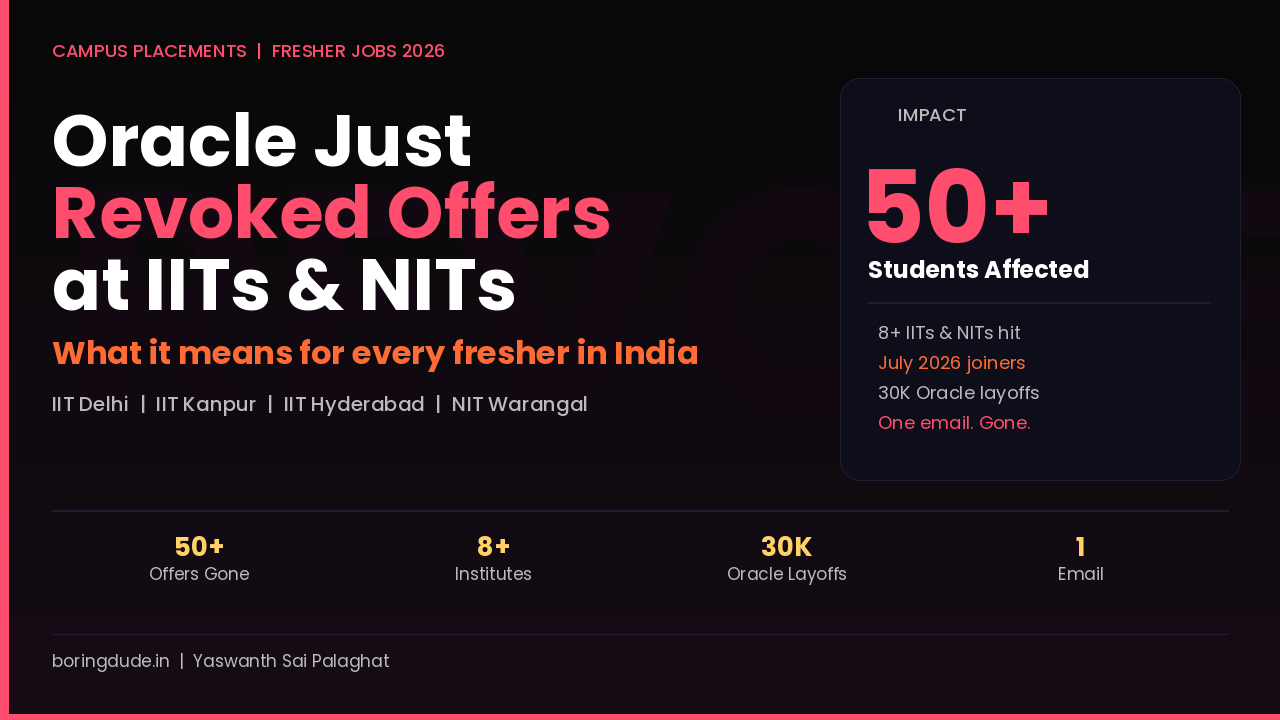
On May 14, 2026, Oracle revoked campus placement offers made to students across IIT Delhi, IIT Kanpur, IIT Kharagpur, IIT Hyderabad, IIT Roorkee, IIT Guwahati, IIT BHU, NIT Warangal, and VNIT Nagpur. More than 50 students were affected in confirmed cases alone. The actual number is likely higher.
Smit Jogani, an IIT Kanpur student whose offer was revoked, put it plainly on LinkedIn: “Hitting rock bottom right at the finish line is tough.”
He is right. And every fresher in India needs to understand exactly why this happened and what it means going forward.
What Oracle Actually Did
This did not happen in isolation. Oracle had already executed what analysts are calling the largest layoff in its 48-year history. On March 31, 2026, Oracle eliminated approximately 30,000 jobs globally. In India alone, around 12,000 employees were let go, nearly half of Oracle’s local workforce. Employees received a five-line email from “Oracle Leadership” with no warning, no HR call, and no manager conversation. Access to company systems was cut off almost immediately.
The reason: Oracle’s Oracle Health division and its application infrastructure business unit were shut down. The company is redirecting billions of dollars toward data centers, GPU clusters, and cloud infrastructure for clients like OpenAI, Meta, and Nvidia. Oracle disclosed a $2.1 billion restructuring plan in its March 2026 SEC filing.
The campus offer revocations in May were the downstream consequence of that April restructuring. The freshers recruited for application developer roles and server technology teams — the exact divisions Oracle just eliminated — found their offers cancelled. They were not the targets of Oracle’s restructuring. They were simply caught in it.
The Institutions Affected
The confirmed numbers paint a specific picture. IIT Guwahati had four of more than ten Oracle offers revoked. IIT Kanpur reported three full-time offer revocations and one internship cancellation. IIT Delhi, IIT Hyderabad, IIT Roorkee, and IIT BHU all reported cases. NIT Warangal confirmed three affected students.
These are not second-tier institutions. These are students who competed in some of the most demanding entrance processes in the world, secured offers from a Fortune 500 company, and were weeks away from their July 2026 joining dates.
The All IITs Placement Committee (AIPC) is now in discussions with Oracle, pushing for a standard compensation of three months’ salary for each revoked offer. Whether Oracle agrees remains to be seen.
The Hidden Trap: One Student, One Offer
The revocation itself is devastating. But the structural problem underneath it makes the situation significantly worse.
Most IITs, NITs, and comparable institutions follow a “one student, one offer” placement policy. Once a student accepts a campus placement offer, they are barred from participating in further placement rounds. The policy was designed for fairness, to prevent students who already have jobs from taking spots from those who do not. That logic is sound.
But the policy was built on an assumption that accepted offers stay stable until the joining date. Oracle just demonstrated that this assumption does not hold. When a company revokes an offer months after placement season closes, affected students face a double loss: they lose the job, and they have already lost access to the campus placement opportunities that were available earlier in the year.
There is no going back to the placement cell in May when most companies have already completed their hiring cycles. The student who was “placed” in November is now unplaced in May, but the system treats them as if they never needed help.
This Is Not New. This Is a Pattern.
Oracle is the latest name on a list that has been growing for years.
In October 2022, Wipro, Infosys, and Tech Mahindra revoked hundreds of offer letters given to freshers, citing “academic eligibility criteria” — language that many students and placement officers believed was a pretext for a broader hiring freeze. Students who had waited months after receiving their letters were suddenly unemployed with no fallback.
In February 2025, Infosys laid off approximately 350 employees who had been taken on board in October 2024 — after a wait of more than two and a half years since their original offer letters.
The 2026 tech layoff wave has now pushed this into sharper focus. More than 100,000 tech jobs have been eliminated globally this year alone. Companies like Cloudflare, Coinbase, Upwork, and Cisco have all cut significant portions of their workforce. When large companies undergo restructuring, the consequences reach campus hiring programs too — and freshers, who have no severance protections or employment records, have the least protection when they do.
What This Means for the Fresher Job Market
Campus placements in India have long been treated as the gold standard of early career stability. A campus offer from a top tech company meant you were set. The placement cell handled the process, the company came to you, and the rest was just waiting for the joining date.
That model is under serious strain. Three things have changed:
First, large tech companies are restructuring around AI much faster than campus hiring cycles can accommodate. A student who received an offer in November for a role that no longer exists by March is not a planning failure by the student — it is a structural mismatch between how companies are moving and how campus hiring works.
Second, the roles that campus freshers are typically hired for — application development, IT support, testing, basic software engineering — are precisely the roles most exposed to AI automation and workforce reduction. These are not the roles companies are growing right now.
Third, the concentration risk of putting everything into one campus offer is now visible in a way it was not before. The “one student, one offer” policy made sense when offers were reliable. It is increasingly risky when they are not.
What Freshers Should Do Right Now
If you are a 2026 batch student waiting on a campus offer, the Oracle situation is not a reason to panic. It is a reason to act.
Build your off-campus presence in parallel. A campus offer should be your floor, not your ceiling. Work on projects, build a GitHub portfolio, contribute to open source, and apply off-campus to companies that are actively hiring in AI-adjacent roles. The talent gap in AI-native skills is estimated at nearly 30 million globally — these companies need people and they are not restricted to campus hiring cycles.
Do not stop learning while you wait. The students who will recover fastest from situations like Oracle’s are the ones who used their waiting period to build skills. Prompt engineering, data pipelines, cloud fundamentals, and AI agent development are all learnable without a degree and directly hireable without a campus process.
Understand the risk of a single point of failure. An offer letter is a document. It is not a job. Until you are receiving a paycheck and working, the offer is a promise from a company that is operating under conditions that can change. That is not cynicism — it is risk management.
Institutions must reform the one-offer policy. This is ultimately a systemic issue that placement cells need to address. If companies can revoke offers, students must retain the right to continue exploring options. A student with a revoked offer should not be starting from zero in May.
The Bigger Picture
Oracle’s campus offer revocation is a symptom of something larger that is reshaping the entire employment landscape for freshers in India. The companies that hire from campuses are the same companies currently restructuring around AI. The roles that campuses fill are the roles most at risk of being eliminated or reduced. The placement policies that campuses follow were designed for a more stable hiring environment than the one that exists today.
None of this means campus placements are worthless. It means they cannot be the only plan. The students who will navigate this period well are those who treat their campus offer as a single data point in a broader career strategy — not as a destination.
Oracle sent one email that changed 50+ students’ lives in an instant. The real lesson is not about Oracle. It is about what happens when you build your entire plan around a single point of contact with the job market.


Happy
0 %

Sad
0 %

Excited
0 %

Sleepy
0 %

Angry
0 %

Surprise
0 %
 0
0
 0
0

