
AI Writes 41% of All Code in 2026 | What Indian Developers Must Do Now
Read Time:7 Minute, 4 Second
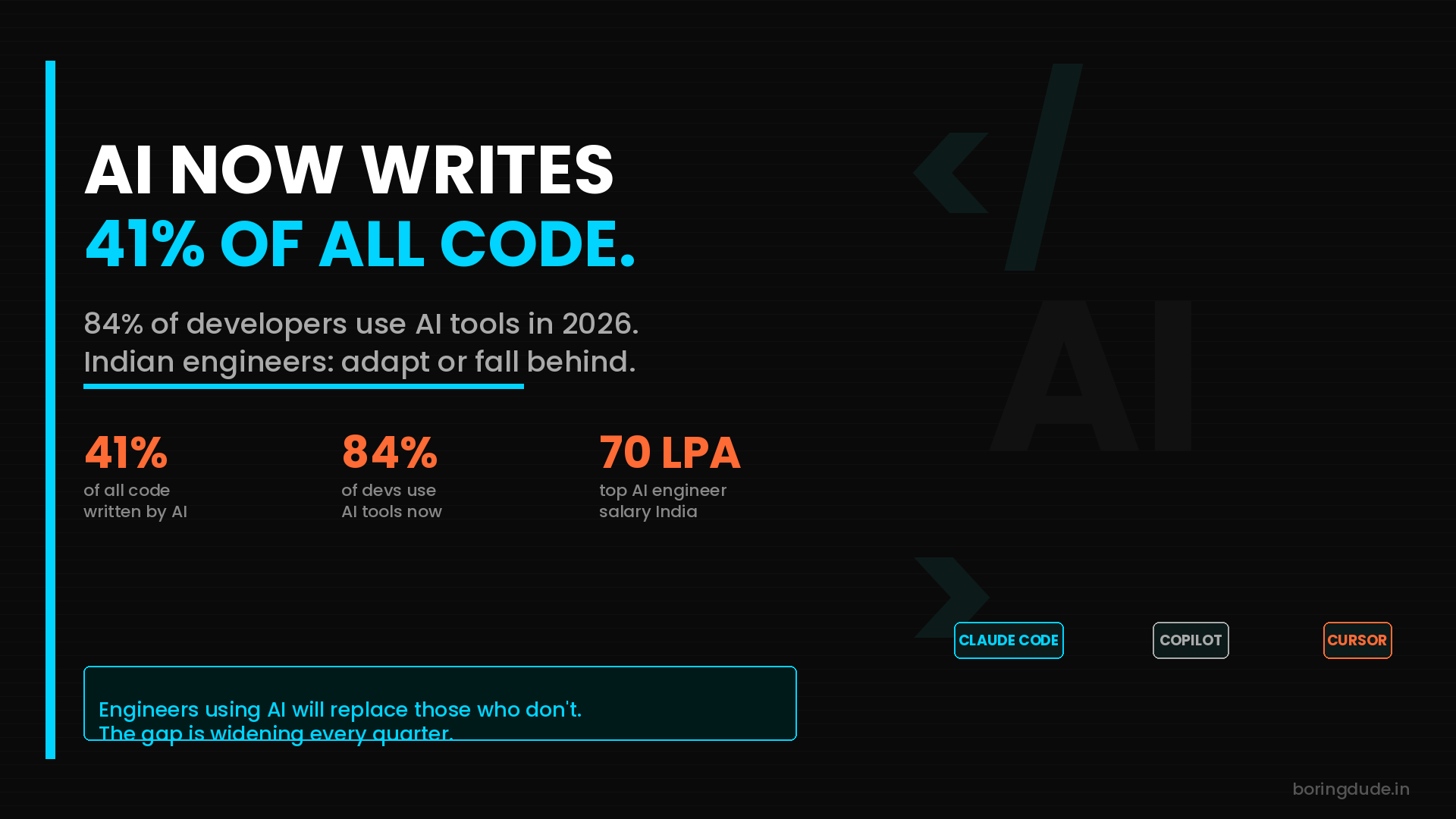
84 percent of developers now use AI tools. AI writes 41 percent of all code produced in 2026. Claude Code became the most-used AI coding tool in the world within months of its launch. These are not predictions. These are numbers from right now.
If you are a software developer or engineer in India and you are not actively using AI tools in your daily workflow, you are not just falling behind. You are competing against someone who does the same work as you in half the time. That someone might be your own teammate.

The Numbers Every Indian Developer Needs to See
Let us start with the data that should get your attention.
In 2026, 84 percent of developers globally are using at least one AI coding tool. AI now writes 41 percent of all code across the industry. That is not a small experimental adoption. That is the new baseline for how software gets built.
Developers who use AI tools report a 10 to 30 percent boost in productivity on average. That number sounds modest until you realize it compounds. A developer who is 20 percent faster ships more features, closes more tickets, and demonstrates more output than a peer who is not using AI. Over one year, that gap becomes impossible to ignore in any performance review.
The top three AI coding tools in 2026 are Claude Code (market leader since May 2025), GitHub Copilot, and Cursor. Claude Code alone crossed $1 billion in run-rate revenue within six months of launch. By early 2026, it surpassed $2.5 billion and now accounts for more than half of all enterprise spending on Anthropic’s products.
That is not a tool people are playing with. That is a tool companies are paying serious money for because it delivers serious output.
What AI Tools Are Actually Doing to Developer Workflows in 2026
Here is what is changing in how engineering teams actually work.
AI coding tools are no longer just autocomplete. That was 2023. In 2026, Claude Code and Cursor handle entire modules. They write tests. They suggest architecture. They explain legacy code in plain language. They debug errors and propose fixes. And newer versions execute multi-step workflows autonomously without needing a developer to handhold every step.
GPT-5.4, launched in March 2026, scored 75 percent on OSWorld, a benchmark that tests an AI’s ability to operate an actual desktop computer. The average human scores 72 percent on the same test. AI is now better than most humans at executing desktop tasks. That is an alarming number.
This does not mean developers are being replaced. It means the nature of what a developer does is shifting. The rote, repetitive, boilerplate-heavy parts of coding are being automated. What remains is design thinking, architectural decisions, product judgment, and domain expertise.
The developers who thrive are the ones who understand both the code and the problem it is solving. The ones who use AI to execute at speed while they focus on the higher-level thinking are the ones getting promoted, getting paid more, and getting hired faster.
Where Indian Developers Stand Right Now
India is the world’s largest market for AI tool adoption in 2026. Bangalore alone accounts for 40 percent of all AI job listings in India. The demand is real, and it is growing fast.
But adoption of AI coding tools among Indian developers is uneven. Senior engineers at product companies in Bangalore, Hyderabad, and Pune are using these tools heavily. Developers at mid-tier IT services companies are lagging. Freshers entering the workforce are often not trained in AI tools effectively during college. That gap is creating two very different career trajectories.
Developer A uses Claude Code, Cursor, and GitHub Copilot daily. Closes tickets 25 percent faster. Gets visibility in team reviews. Gets promoted ahead of peers.
Developer B sticks to the old workflow. Does not use AI because it feels like cheating or the output needs checking. Falls behind on output. Gets passed over in performance reviews.
In 2026, that gap is widening every quarter. And once it opens wide enough, it is very hard to close.
What Salaries Look Like for AI-Skilled Engineers in India
Here is where the career case becomes impossible to ignore.
Freshers entering the AI and ML space in India in 2026 start at 5 to 9 LPA, depending on skills and location. Engineers with 3 to 5 years of experience who have built genuine AI skills see packages ranging from 10 to 40 LPA. Senior specialists in Generative AI, LLMs, and MLOps command 40 to 70 LPA in active hiring markets.
Bangalore-based AI engineers earn 15 to 20 percent more than their counterparts in tier-2 cities. And salary growth for AI-skilled engineers is running at 15 to 20 percent year on year, far above the average IT industry average right now.
By contrast, engineers in traditional development roles with no AI skills are seeing salary growth flatten. Some companies have quietly started offering lower packages for roles where AI tools can now handle large portions of the work with less human oversight.
The market is pricing AI skills aggressively. That trend is not slowing down in 2026.
The Exact Skills to Build Right Now
Here is what to focus on if you are an Indian developer trying to stay ahead.
First, learn to use Claude Code, Cursor, or GitHub Copilot properly in your actual work. Not just as autocomplete. Learn to write effective prompts, review AI-generated code critically, and integrate these tools into your real daily workflow. Most developers use these tools at 20 percent of their actual capability.
Second, focus on prompt engineering for code. Writing precise prompts for AI coding assistants is a genuine skill that takes practice. The developers who can direct AI tools accurately get dramatically better output than those who type vague requests.
Third, build your architecture and system design skills. This is the work that AI still cannot do well. Designing scalable systems, making trade-off decisions, and thinking about long-term technical direction. This is where human judgment still dominates and will continue to dominate for years.
Fourth, specialize in AI and ML engineering if you want the fastest salary growth. Generative AI, LLMs, MLOps, vector databases, and AI infrastructure are the highest-growth areas in Indian tech right now. Combining software engineering fundamentals with these skills puts you in a very strong position.
Fifth, ship public work. GitHub contributions, open source, technical blog posts, and LinkedIn content about what you are building. In 2026, your visible track record matters more than your resume for getting noticed by the right companies and the right hiring managers.
Key Takeaways
- 84 percent of developers globally use AI coding tools in 2026. AI writes 41 percent of all code. This is the new baseline, not a trend.
- Claude Code is the market leader at $2.5 billion in run-rate revenue. Cursor and GitHub Copilot are widely adopted in enterprise teams across the world.
- AI-skilled engineers in India earn 10 to 70 LPA depending on experience, with 15 to 20 percent year-on-year salary growth. Traditional developers without AI skills are seeing flat growth.
- The shift is from writing code to directing AI. Developers who master AI tools and combine that with architecture and domain expertise have the strongest career trajectory in 2026.
- Adoption among Indian developers is uneven. This is both a warning and a massive opportunity, depending on which side of the gap you are on today.
My take? I have been saying this for over a year now. Engineers using AI will replace engineers who do not. That is not a prediction anymore. That is a description of what is happening in 2026 in every engineering team I speak to.
The good news is that learning any skill these days is not really difficult. These tools are accessible. The resources are free. The communities are massive. The only thing stopping most developers from adopting AI tools properly is inertia and the initial discomfort of change.
Fix that. Start today. Pick up Claude Code or Cursor. Use it on your next real work task. Get uncomfortable for a week. Then watch your output change completely.
What do you think? Drop your thoughts in the comments.


Happy
0 %

Sad
0 %

Excited
0 %

Sleepy
0 %

Angry
0 %

Surprise
0 %
 0
0
 0
0

