
Managers Are the New Freshers: AI Wipes Out Middle Management in 2026
Read Time:5 Minute, 38 Second
For the first time in history, AI is officially the number one reason companies are cutting jobs. Not restructuring. Not market conditions. Not cost-cutting. AI. And the first targets are not freshers or junior developers. The first targets are the people in the middle, project managers, program managers, team leads, QA engineers, and the layer of management that coordinates and reports.
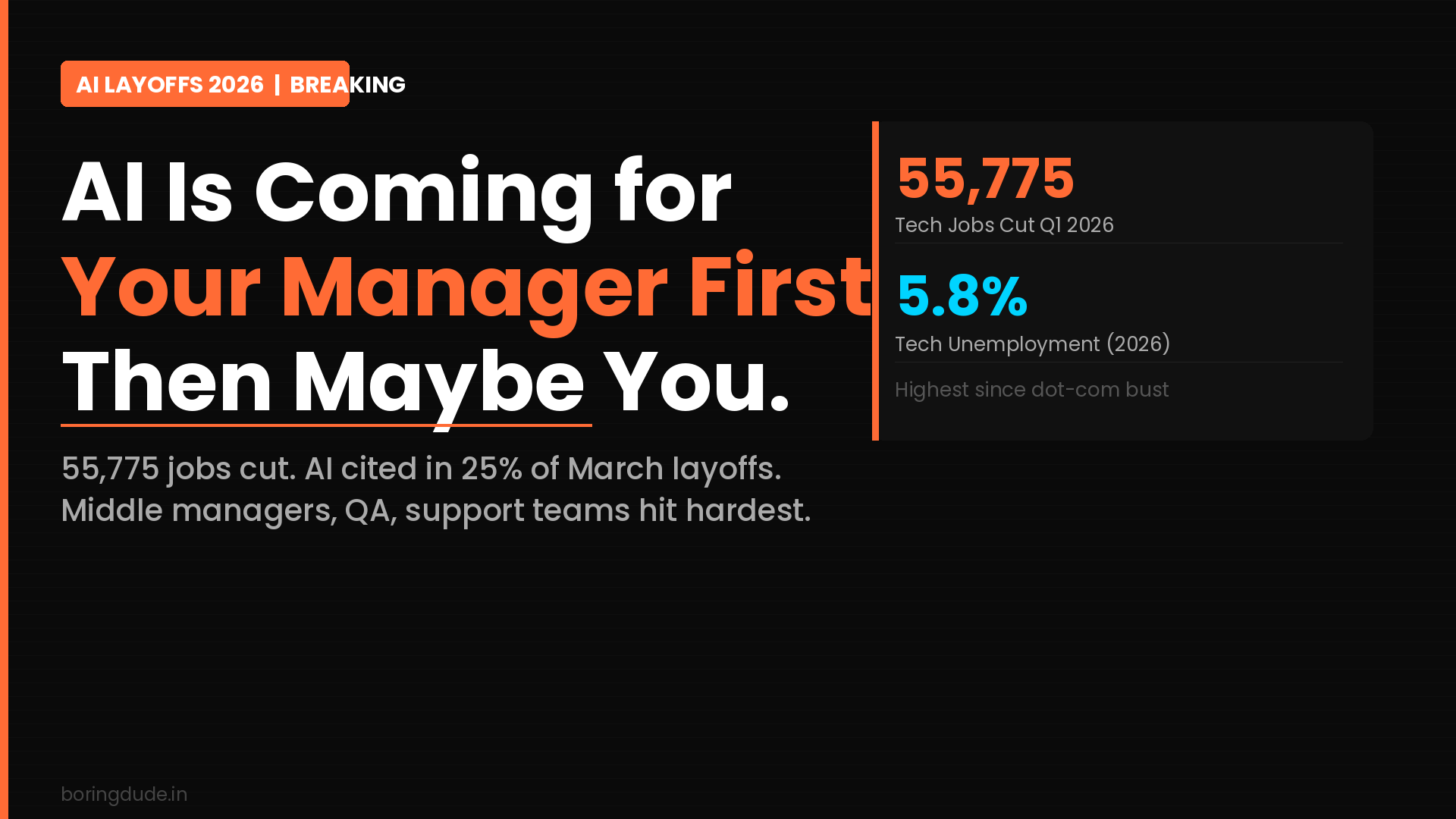
55,775 tech jobs were cut in the first 74 days of 2026 across 166 companies. AI was cited in 25% of all March layoffs, accounting for 15,341 positions in a single month. The CFOs who are doing this are privately saying the AI-driven job cuts will be 9 times higher than public estimates. This is not slowing down. It is accelerating.

Why Middle Management Is the First Target
Companies are flattening their organizations. They are removing layers. And the layer they are removing first is middle management, the people whose primary job is to coordinate work, track progress, run status meetings, and write reports.
AI tools can now do most of that. Project tracking, progress reports, status updates, resource allocation, all of this can be automated or dramatically compressed by AI systems. What used to need a team of 6 managers now needs maybe one senior person and a few AI agents running in the background.
The data backs this up. The manager-to-IC ratio has gone from 1:6 to 1:10 or beyond at multiple major companies. Amazon’s recent “anti-bureaucracy” layoffs specifically called out managers and program managers. Microsoft, Meta, and others have been on the same path.
This is not a trend that is coming. This is a trend that is happening right now.
The Jobs Being Cut and the Data Behind It
Let me break down exactly which roles are being hit hardest in 2026:
Project managers and program managers whose main job is coordination are the primary target. When AI can track tasks, generate status reports, and flag risks automatically, companies see an entire layer of cost they can remove.
QA engineers are being cut hard. Atlassian was direct about this. They stated that AI tools reduced their need for manual testing by approximately 60%. Testing, bug tracking, and regression checks. AI is doing all of this faster and at scale.
Customer support teams are shrinking down to escalation specialists. AI agents are handling 60 to 80 percent of inbound tickets at companies like eBay and ANGI. The humans remaining handle only the complex edge cases that the AI cannot resolve.
Content teams and internal IT roles are also getting hit. AI writing tools have compressed content production dramatically. Internal IT helpdesks are being replaced by AI agents that resolve common issues without human intervention.
The Re-employment Problem Nobody Is Talking About
Getting laid off used to be painful but temporary. The data from 2026 shows something more alarming. The tech sector unemployment rate has climbed to 5.8 percent. That is the highest level since the dot-com bust of 2001 to 2002. And the median time to find a new job after a tech layoff has jumped from 3.2 months in 2024 to 4.7 months in early 2026.
Why? Because the same AI tools that eliminated your job are also changing what the next job looks like. Companies are not hiring the same roles back. They are hiring fewer people with broader skills who can work alongside AI tools. The job description has changed. The people looking for work have not changed yet.
That gap is the real problem.
What India’s Tech Industry Needs to Understand
India’s IT sector has historically been built on middle management. The model was simple. Hire large teams, layer management on top, and deliver service contracts to global clients. That model is now structurally under threat.
TCS, Infosys, and Wipro have all been talking about AI-driven efficiency. What that actually means is they can deliver the same output with fewer people. The bench strength model, hiring lots of people and placing them on projects, is becoming harder to justify when AI can fill gaps faster and cheaper.
The 80 percent collapse in Indian IT fresher hiring we tracked earlier this year is part of the same story. Companies are not rebuilding with headcount. They are rebuilding with tools.
This is not a reason to panic. It is a reason to adapt and adapt fast.
What You Should Do Right Now If Your Role Is at Risk
The roles that survive in a world with AI are the roles where humans bring something AI cannot. Judgment, stakeholder relationships, domain expertise, cross-functional leadership, creative problem-solving. The people who know how to use AI tools to do more work themselves, without needing a coordinator layer under them, are the ones who stay.
Three things matter most right now:
First, learn to use AI tools for your actual work. Not as a curiosity but as your daily workflow. If you are a project manager, use AI to automate your reports and tracking and use the time you save to solve harder problems your manager cannot see.
Second, expand your scope. Narrow specialists in lower-stakes functions are the easiest to eliminate. People who can contribute across multiple areas and make judgment calls that have real business impact are much harder to cut.
Third, understand the AI tools your company is evaluating. If you know what is coming before it arrives, you can position yourself as the person who helps implement it rather than the person who gets replaced by it.
Key Takeaways
- AI is now the number one cited reason for job cuts globally, accounting for 25 percent of all March 2026 layoffs.
- Middle management is the primary first target: project managers, program managers, and team leads whose main job is coordination.
- QA, content, customer support, and internal IT roles are also being hit hard across major companies.
- Tech unemployment hit 5.8 percent, the highest since the dot-com bust, and re-employment now takes 4.7 months on average.
- The roles that survive are those requiring genuine judgment, stakeholder management, and AI-augmented execution.
My take? This is a structural shift, not a cycle. The people who treat this as a temporary downturn and wait for it to pass are going to wait a long time. The people who use this moment to build new skills, understand AI tools deeply, and expand their scope within their organizations are going to be fine. The gap between those two groups is growing every month.
What do you think? Drop your thoughts in the comments.


Happy
0 %

Sad
0 %

Excited
0 %

Sleepy
0 %

Angry
0 %

Surprise
0 %
 0
0
 0
0

