
NVIDIA Vera Rubin H300: 5x Faster AI Is Here in 2026
Read Time:4 Minute, 39 Second
NVIDIA just dropped the Vera Rubin H300 at GTC 2026. And if you are working in AI, building products on AI, or investing in anything AI-related, you need to understand what this chip actually means for you. This is not just another GPU launch. This is a 5x performance leap in a single generation.
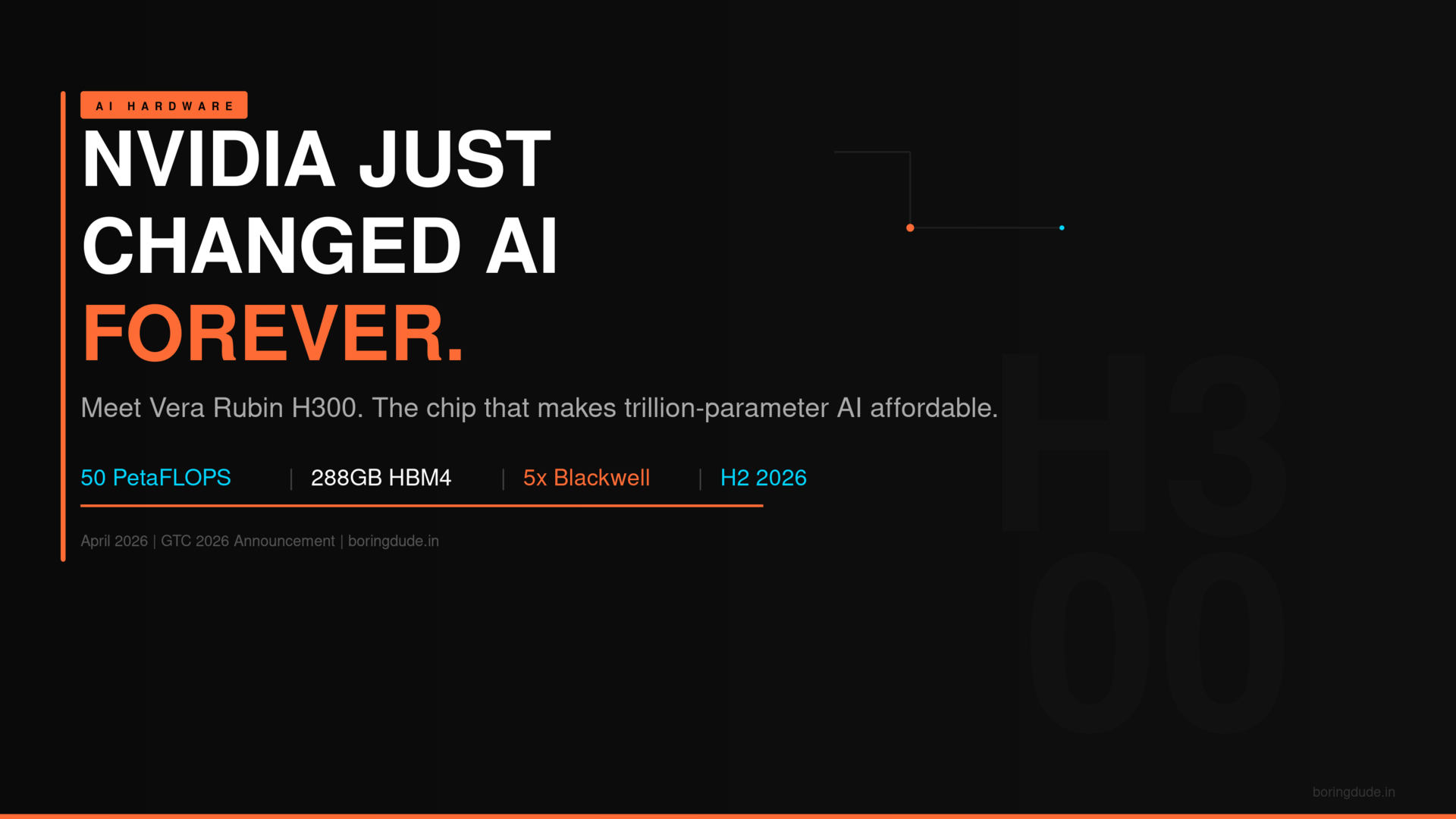
The H300 delivers 50 PetaFLOPS of FP4 compute, 288GB of HBM4 memory at 22 TB/s bandwidth, and 8 times better inference performance per watt compared to Blackwell. Those numbers are not incremental upgrades. They are a reset. The AI industry just got a completely new baseline.

What Is the Vera Rubin H300 and Why Does It Matter
The Vera Rubin H300 is NVIDIA’s next flagship AI accelerator, built on TSMC’s 3nm process with a dual-die chiplet design packing 336 billion transistors. That is a 1.6x increase over Blackwell’s 208 billion transistors.
The memory configuration is where things get wild. 288GB of HBM4 at 22 TB/s. Blackwell was running HBM3e at around 8 TB/s. NVIDIA just gave you 2.8 times more memory bandwidth in one generation.
Why does bandwidth matter? Because the bottleneck for large language models is not compute. It is moving data around. More bandwidth means faster token generation, lower latency, and the ability to run trillion-parameter models that previously needed entire data centers.
The 5x Compute Leap That Changes Agentic AI Forever
50 PetaFLOPS of FP4 compute. Five times what Blackwell could do. Let that number sink in.
This is not a tweak. NVIDIA shipped 10 PetaFLOPS with Blackwell and jumped to 50 in the next cycle. That kind of scaling means AI tasks that used to require five H100s can now run on one H300. Costs drop. Inference gets faster. Products get better.
The agentic AI use case is where this matters most. Agents need to make fast decisions, process long contexts, and run multiple chains simultaneously. H300 makes that not just possible but affordable for companies that are not OpenAI or Google.
8x Better Inference Efficiency. This Is Huge for India’s AI Startups
Eight times better inference performance per watt. This is the number that matters most for startups and businesses actually deploying AI.
Running AI models at scale is expensive. Inference costs eat into margins fast. Every company building on top of LLMs knows this pain. GPT-4 API costs, Anthropic Claude credits, or the cost of running your own models. It adds up.
H300 changes the math. Eight times more work per unit of energy means cloud providers can offer AI inference at a fraction of today’s cost. For Indian AI startups building on top of hosted models, this trickles down to cheaper APIs and more competitive pricing by late 2026 and into 2027.
Infosys, Wipro, TCS, and the big Indian IT companies investing in AI infrastructure should be watching this closely. The companies that lock in H300 capacity early will have a serious cost advantage over those running on older GPU stacks.
When Can You Get It and What Does Full Production Mean
NVIDIA confirmed Vera Rubin is in full production. Partner products go on sale in the second half of 2026.
Full production is a key phrase here. NVIDIA announced Blackwell and then faced supply constraints for months. By saying full production now, Jensen Huang is signaling that supply will not be the bottleneck this time around.
Hyperscalers like AWS, Azure, Google Cloud, and Oracle Cloud are already placing orders. H300-backed cloud instances will start appearing in H2 2026. Expect inference APIs built on H300 to start showing up with lower pricing and higher speed benchmarks shortly after.
What This Means for Jobs and Skills in 2026
NVIDIA releasing a chip this powerful has a second-order effect that most people miss. It does not just change what AI can do. It changes what AI engineers, ML researchers, and infrastructure teams need to know.
Companies will need people who understand HBM4 memory optimization, agentic pipeline design, and trillion-parameter model deployment. These are not skills most software engineers have today.
If you are a fresher or a mid-level engineer trying to figure out where to invest your learning time in 2026, the answer is clear. Learn how to work with inference optimization, understand model quantization, and get hands-on with frameworks like vLLM and TensorRT-LLM. These skills will be in massive demand the moment H300-backed cloud instances go live.
Key Takeaways
- NVIDIA Vera Rubin H300 delivers 50 PetaFLOPS, 5x faster than Blackwell, shipping H2 2026.
- 288GB HBM4 at 22 TB/s means trillion-parameter models become practical at scale.
- 8x better inference per watt means AI costs will drop significantly for startups and businesses.
- Indian IT companies and AI startups should plan for H300-based cloud infrastructure by late 2026.
- Skills in inference optimization and large model deployment will be among the most in-demand by 2027.
My take. The pace at which NVIDIA is shipping is unbelievable. Blackwell was already a massive step up. H300 makes Blackwell look slow. We are in a period where AI hardware doubles in capability every 12 to 18 months, and the companies and individuals who understand what that means for their strategy will be the ones who come out ahead. The age of trillion-parameter AI being accessible is here. The question is what you are going to build with it.
What do you think? Drop your thoughts in the comments.


Happy
0 %

Sad
0 %

Excited
0 %

Sleepy
0 %

Angry
0 %

Surprise
0 %
 0
0
 0
0

