
Google’s Quantum Computer Can Crack Bitcoin in 9 Minutes | Boringdude.in
Read Time:6 Minute, 30 Second
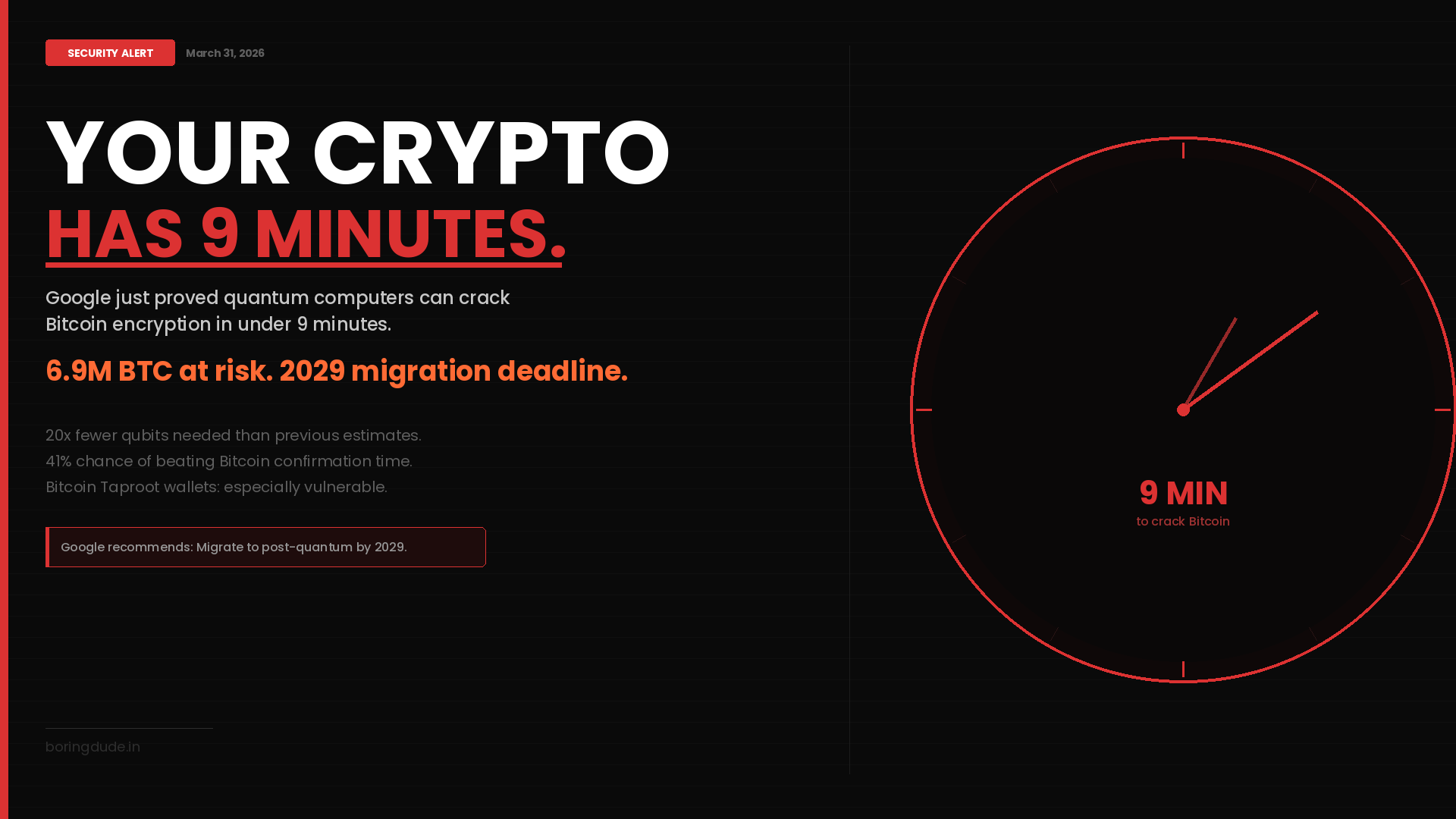
On March 31, 2026, Google’s Quantum AI team dropped a whitepaper that should concern every person who owns crypto, uses internet banking, or relies on digital encryption for anything. Their finding is alarming and straightforward: a sufficiently advanced quantum computer could crack Bitcoin’s private key encryption in approximately 9 minutes. Not years. Not months. Nine minutes.
This is not science fiction. This is Google, one of the most credible research organizations in the world, telling us the timeline is shorter than we thought. And if you own crypto, work in cybersecurity, or care about the future of digital privacy, you need to understand what this means right now.

What Google Actually Found
The whitepaper from Google Quantum AI focuses on elliptic curve cryptography, or ECC. This is the mathematical foundation that secures Bitcoin, Ethereum, and most modern encryption systems on the internet, including HTTPS. It is the lock on the door of the entire digital economy.
Previous research estimated that breaking ECC would require millions of physical qubits on a quantum computer. That felt comfortably far away from today’s technology. Google’s new paper changes that math dramatically.
Their improved quantum algorithms can break the same encryption with fewer than 500,000 physical qubits. That is 20 times fewer than previous estimates. They also showed that just 1,200 to 1,450 logical qubits combined with around 70 to 90 million Toffoli gates would be sufficient. In computational terms, this is a massive reduction in the resources required.
The practical implication is this. A quantum computer with these specifications could intercept a Bitcoin transaction the moment your public key becomes visible on the network, calculate your private key, and redirect your funds. All in about 9 minutes. With a 41% success rate of beating Bitcoin’s own confirmation window.
Why Bitcoin’s Taproot Upgrade Makes This Worse
Here is the part that most crypto coverage is missing. Bitcoin’s Taproot upgrade, which was activated in 2021 to improve privacy and efficiency, has an unintended consequence in a quantum world. Taproot makes public keys visible by default on the blockchain.
In Bitcoin’s original design, your public key was only exposed for a brief window during a transaction. Attackers had a narrow time window to exploit. With Taproot, public keys are permanently visible on-chain even before a transaction is initiated.
This means attackers with a sufficiently powerful quantum computer would not need to intercept a live transaction. They could scan the blockchain, identify exposed public keys, and target wallets at any time. Google estimates that approximately 6.9 million Bitcoins are currently held in wallets whose public keys are already exposed this way.
At current prices, that is hundreds of billions of dollars sitting in wallets with a future vulnerability already visible on a public ledger. The problem is not theoretical. The keys are already out there.
How Google Disclosed This Without Making It a Weapon
This is one of the more interesting parts of this story. Google did not publish a step-by-step guide to breaking Bitcoin. They used a technique called a zero-knowledge proof to validate their findings. This means they proved the vulnerability is real without revealing the method that would let bad actors reproduce the attack.
This is responsible disclosure at a massive scale. They are essentially saying: “We found the hole. We are not going to draw a map to it. But we are telling you it exists so you can fix it before someone else finds it without our ethical framework.”
The crypto community has responded with a mix of alarm and urgency. Bitcoin developers, Ethereum researchers, and major exchanges are now accelerating work on post-quantum cryptography upgrades. The question is whether they can move fast enough.
The 2029 Deadline and What Post-Quantum Means
Google has set 2029 as its internal deadline for migrating its own systems to post-quantum cryptography. This is not a soft recommendation. They are telling the world that quantum computers capable of breaking today’s encryption could exist by 2032, and responsible organizations need to be ready 3 years before that.
Post-quantum cryptography refers to a new class of encryption algorithms that are designed to resist attacks from quantum computers. The US National Institute of Standards and Technology (NIST) finalized its first set of post-quantum encryption standards in 2024. The tools exist. The problem is adoption speed.
For individual crypto holders, the practical advice right now is clear. If your Bitcoin wallet’s public key is already visible on the blockchain, your funds are at risk. Moving funds to a fresh wallet with an unexposed public key reduces your exposure. Long term, every blockchain and every internet protocol will need to migrate to post-quantum standards. This is not optional. It is a matter of when, not if.
What This Means for India and Indian Tech Professionals
India has the largest number of crypto retail investors in Asia by user count. Millions of people in India hold Bitcoin and Ethereum in personal wallets, many without understanding what ECC is or why it matters. The Taproot vulnerability means that a portion of those wallets have already exposed public keys.
For Indian IT professionals and cybersecurity experts, this is a direct career signal. Post-quantum cryptography is going to be one of the most in-demand skill areas of the next decade. Banks, fintech companies, government digital infrastructure, and every enterprise running HTTPS will need to migrate. The engineers who understand quantum-safe protocols right now will be in extraordinary demand by 2028.
If you are in cybersecurity, start reading NIST’s post-quantum standards. If you are in blockchain development, understand what your chain’s quantum migration plan looks like. If you own crypto, audit your wallets and understand your exposure.
My Take
I want to be clear about something. Google is not saying quantum computers can break Bitcoin today. They are saying the gap between current technology and the threat is much smaller than we assumed. The timelines have compressed. And the specific number of 9 minutes is not a current capability. It is a projection based on hardware that is likely 5 to 7 years away.
But here is the thing about security. You do not prepare after the threat arrives. You prepare while you still have time. Google just told us the time we have is shorter than we thought. That is the warning. Whether individuals, institutions, and blockchains act on it will define the next decade of digital security.
Q-Day is not a movie. It is a real engineering deadline. And the countdown has officially started.
Key Takeaways
- Google’s Quantum AI whitepaper (March 31, 2026) shows that Bitcoin’s encryption can be cracked in 9 minutes by a sufficiently advanced quantum computer, with a 41% success rate of beating the confirmation window.
- The resources needed to break Bitcoin’s ECC are 20X fewer than previous estimates. Less than 500,000 physical qubits instead of millions.
- Bitcoin’s Taproot upgrade means 6.9 million BTC wallets already have exposed public keys, making them especially vulnerable when quantum hardware becomes powerful enough.
- Google used a zero-knowledge proof to reveal the vulnerability responsibly, without publishing a usable attack method.
- Google’s 2029 deadline for post-quantum cryptography migration gives the industry roughly 3 years to fix systems before Q-Day potentially arrives around 2032.
- For Indian IT and cybersecurity professionals, post-quantum cryptography is going to be one of the most in-demand skills of the next decade.
The digital lock on the global economy has a known expiry date. The question is whether the internet migrates fast enough. What do you think? Drop your thoughts in the comments.


Happy
0 %

Sad
0 %

Excited
0 %

Sleepy
0 %

Angry
0 %

Surprise
0 %
 0
0
 0
0

