
India IT Fresher Hiring Collapsed 80% in 2026 | Boringdude.in
Read Time:5 Minute, 23 Second
If you graduated in 2023 or 2024 and are still waiting for that TCS or Infosys joining letter, you are not alone. India’s IT fresher hiring has collapsed by 80% from its peak. 55,000 tech jobs have been cut globally in just the first 3 months of 2026. And the biggest companies justifying these cuts are pointing to the same reason. AI.
But here is what nobody is telling you. The jobs are not gone. They moved. And if you know where to look, 2026 might still be your year. Let me break this down completely.

The Numbers Are Alarming
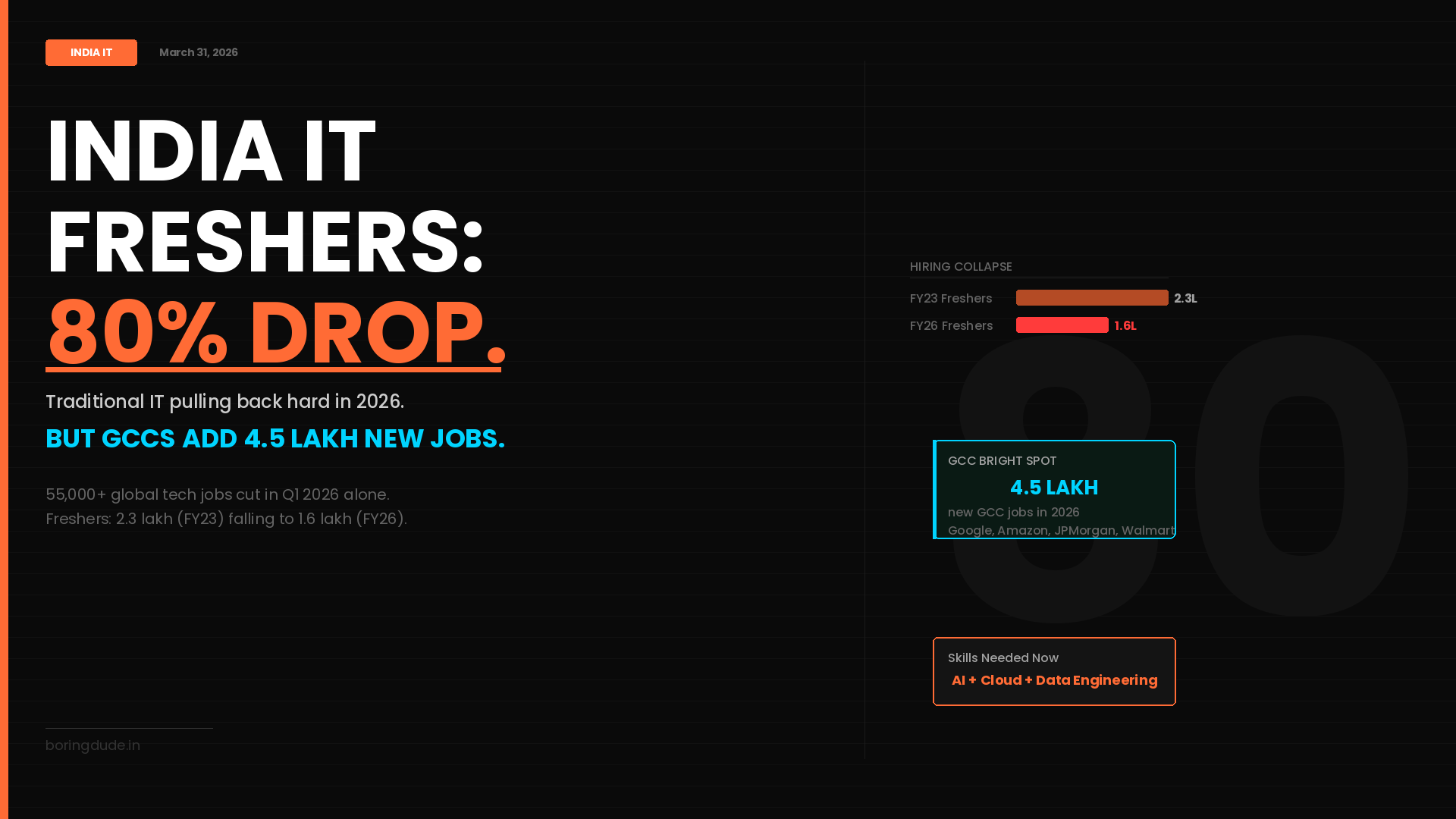
Let me put the data in front of you first. In FY23, roughly 2.3 lakh freshers were hired by Indian IT companies. In FY26, that number is expected to drop to 1.6 lakh. That is a 30% drop in absolute terms. But from the peak hiring years, the fall is closer to 80%.
Globally, over 55,000 tech jobs were cut in the first 3 months of 2026 alone. Amazon restructured teams in Bengaluru, Chennai, and Hyderabad in January. Atlassian cut 10% of its workforce in March, affecting India significantly. And the pattern is clear. Nearly 80% of these cuts are coming from US-headquartered companies.
For freshers who are still waiting for joining letters, this is real. Companies like Tech Mahindra reportedly still have nearly 1,000 candidates waiting on deferred joining. Offers were made. Joining dates were pushed. Again and again.
Why Is This Happening
This is not a recession. This is a structural shift. Every major company cutting jobs right now is pointing to the same thing. AI is doing work that used to require large teams of people.
The traditional IT services model was built on volume. You hire thousands of freshers, train them, and deploy them on client projects. That model worked when software development required lots of hands. But AI tools are now doing a significant portion of the coding, testing, and documentation work that freshers used to do.
Companies are not cutting costs because business is bad. Many are actually growing. They are cutting people because productivity per person has gone up dramatically. One senior engineer with AI tools can now do the work that used to require 3 or 4 junior engineers. That math directly hurts fresher hiring.
Infosys, TCS, and Wipro are all dealing with this reality. They built massive training programs for freshers. But if clients are not paying for the large teams they once needed, the economics of fresher hiring do not work anymore.
Who Is Still Hiring? The GCC Boom.
Here is the part that does not make headlines but should. Global Capability Centres are booming. These are the India offices of global companies like Google, Amazon, Microsoft, JP Morgan, Goldman Sachs, Walmart, Caterpillar, and Shell.
In 2026, GCCs are expected to add 4.25 to 4.5 lakh jobs across India. Hyderabad, Bengaluru, and Pune are the primary destinations. By 2030, projections show GCCs adding 1 million jobs. That is not a typo. One million jobs.
The GCC model is fundamentally different from traditional IT services. Instead of billing clients by the hour, GCCs build internal products and capabilities for their parent companies. They need people who can build, not just maintain. And right now, they are actively hiring in AI, platform engineering, data security, and core engineering.
What Skills Do You Need for GCC Jobs
This is the practical part. GCC jobs are not volume-hire roles. They are not going to take 500 freshers and train them from scratch. They want people who are already competent in specific areas.
The skills that GCCs are hiring for right now are AI and machine learning, cloud platforms (AWS, Azure, GCP), data engineering and analytics, platform security, and full-stack development with modern frameworks. If you are a fresher or an early-career professional, your job is to pick one of these tracks and go deep. Not a broad overview. Actual project-level depth.
The good news is that you do not need a corporate job to build these skills. AWS and Google have free learning paths. Kaggle has competitions that become real portfolio projects. Claude Code and other AI tools let you build things faster than ever before. The barrier to building a credible portfolio has never been lower.
Freshers who show up to GCC interviews with real projects, even small ones, are getting noticed. Freshers who show up with just a degree and a course certificate are not.
My Honest Take
I know this is a hard time if you are a fresher or someone who has been waiting for months. I am not going to sugarcoat it. The traditional IT services path is genuinely narrowing. The days of mass fresher hiring at TCS and Infosys are not coming back the way they were. That era is over.
But the opportunity in India’s tech sector has never been bigger. GCCs are not slowing down. AI companies need Indian talent. The demand is real. The gap is skills alignment, not a lack of jobs.
The students who are going to win in 2026 and beyond are the ones who stop waiting for the job market to go back to normal and start building skills that match where the market is going. AI, cloud, and data are not trends. They are the new baseline.
Key Takeaways
- India IT fresher hiring has dropped 80% from its peak. In FY26, only 1.6 lakh freshers are expected to be hired versus 2.3 lakh in FY23.
- 55,000 global tech jobs were cut in Q1 2026 alone. Amazon, Atlassian, and others are restructuring India teams.
- The reason is structural. AI is doing work that previously required large fresher cohorts. This is not a temporary downturn.
- GCCs are the real opportunity. 4.5 lakh new jobs in 2026. 1 million jobs by 2030. Companies like Google, Amazon, JP Morgan, and Walmart are actively building in India.
- GCC roles require real skills, not just degrees. AI, cloud, data engineering, and full-stack development are the entry points. Build projects. Not just certificates.
The job market has not disappeared for Indian tech talent. It has shifted. The question is whether you are shifting with it. What do you think? Drop your thoughts in the comments.


Happy
0 %

Sad
0 %

Excited
0 %

Sleepy
0 %

Angry
0 %

Surprise
0 %
 0
0
 0
0

