
Dario Amodei Just Published His Most Important Essay. Here Is What He Is Asking For.
Read Time:8 Minute, 35 Second
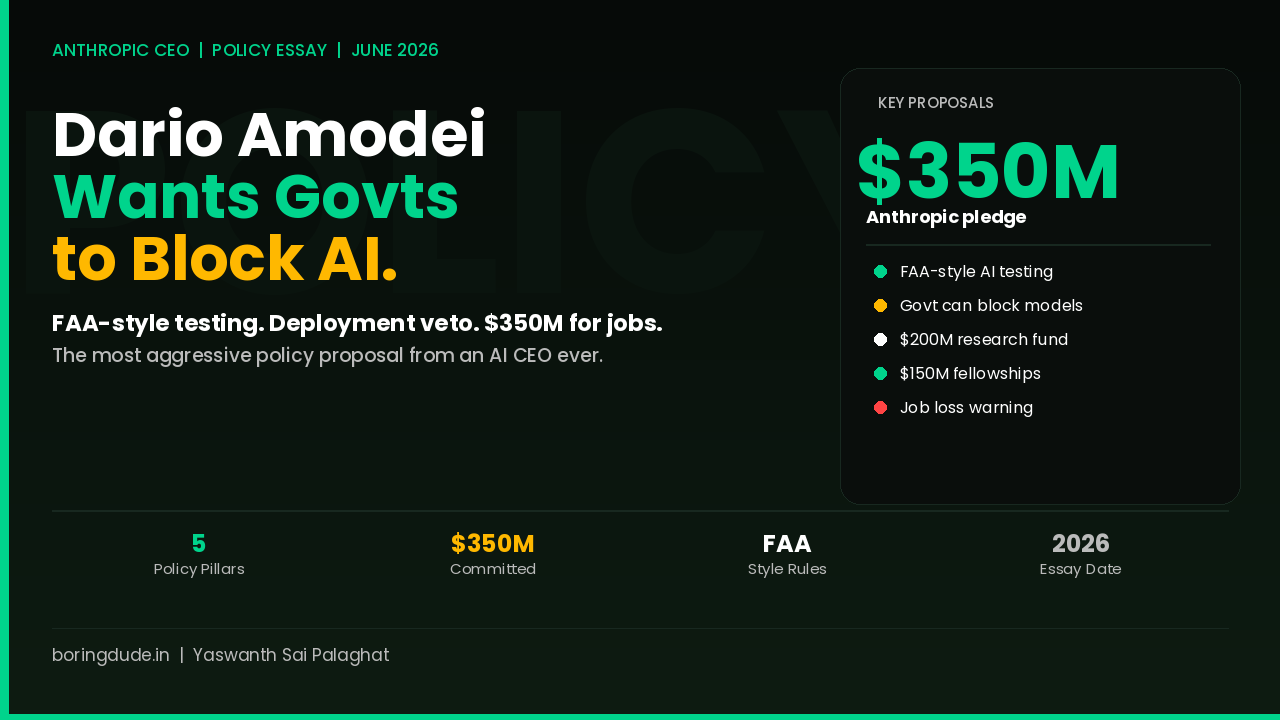
The CEO of one of the world’s most powerful AI companies just published an essay calling on governments to regulate AI more aggressively than any major lab has ever publicly asked for. Dario Amodei, the founder and CEO of Anthropic, released “Policy on the AI Exponential” in June 2026. It is the most significant public statement any AI lab leader has made about the need to constrain their own industry.
This is not a PR move or a vague call for responsibility. It is a specific, detailed policy proposal covering five major areas of governance, backed by $350 million in Anthropic funding commitments. Here is what he is actually asking for, and why it matters.
The Treebeard Problem
Amodei opens the essay with an analogy from The Lord of the Rings. Treebeard is a wise but slow-moving sentient tree that the Hobbits need to rouse quickly to defend a forest being cut down. The problem: Treebeard operates at a fundamentally different speed than the threat he needs to respond to.
That is how Amodei describes the situation between AI progress and government policy. AI has gone from barely writing coherent code to writing most of the code at major AI companies in four years. Legislation takes years. By the time Congress acts, AI will have compounded several more times over.
The essay marks a shift in Amodei’s public position. Until now, Anthropic has advocated for transparency legislation, helping pass laws in California, New York, and Illinois that require disclosure of safety procedures. Amodei says that was the right call in 2024, when the shape of AI risks was still unclear. Now, he says, the risks are clearly here, and transparency is no longer enough.
Pillar 1: FAA-Style Regulation for AI Models
The most significant proposal in the essay is a call for mandatory pre-release testing of frontier AI models, modeled on how the FAA certifies airplanes before they fly.
Amodei proposes that any AI model above a certain compute threshold must undergo mandatory third-party testing in four specific risk areas before it can be deployed. Those four areas are cybersecurity, biological weapons, loss of control of AI systems, and automated AI research that could accelerate the other three risks.
Crucially, he proposes that the government should have the legal power to block or reverse the deployment of a model if it fails that testing. This is not a notification requirement or a transparency rule. It is a deployment veto for the government over frontier AI models that pose unacceptable risks.
Amodei notes that this proposal goes further than the Trump administration’s June 2026 executive order on AI, which he says moves incrementally in the right direction but does not go far enough. He is publicly asking for stronger action than the current administration has taken.
The essay also calls for mandatory security standards to protect model weights, regular red-teaming and penetration testing by AI companies, and prompt reporting of safety incidents in the four critical risk areas.
Pillar 2: Jobs, Labor Displacement, and $350 Million
This is the section of the essay that is most relevant to the average person, and where Amodei is most candid about what AI might do to employment.
He does not soften the message. He writes that there is a decent possibility that AI causes significant enduring job loss, and that this may be an intrinsic property of the technology. He distinguishes AI from previous waves of automation by pointing out that it broadly replicates human cognition, not just physical tasks. The usual adaptive mechanisms, like comparative advantage and Jevons paradox, may be overwhelmed by the pace of the technology.
He calls for measurement and tracking of AI job displacement, pro-employment tax incentives and wage insurance, and long-term macroeconomic support including universal basic income financed through taxes on AI companies and higher capital gains taxes if displacement ends up being large and permanent.
Alongside the essay, Anthropic committed $350 million to back this up. The commitment is split into a $200 million Economic Futures Research Fund and a $150 million national fellowship program for early-career Americans at risk of job loss from AI. These are not vague pledges. They are specific, funded commitments tied to the policy proposals in the essay.
Pillar 3: Fixing Science Regulation Before AI Breaks It
Amodei argues that while AI itself needs tighter regulation, the downstream applications of AI, especially in biomedicine, need looser and faster regulation. The existing FDA approval process takes 7 to 8 years for a drug candidate. AI is going to flood that pipeline with candidates at a pace the current system cannot handle.
He calls for the FDA and EMA to develop standards now for accepting AI-based simulation and analysis in place of expensive and slow traditional experiments. Specifically: AI-based pharmacokinetics modeling, toxicology prediction to reduce animal trials, biomarker validation from large datasets, and synthetic control arms in clinical trials to reduce patient recruitment needs.
The logic is straightforward. If AI is going to accelerate the pace of drug discovery by 10 times, the regulatory system needs to be ready to process those candidates or the bottleneck just shifts from discovery to approval. The benefits of AI in medicine get delayed while the risks loom large.
Pillar 4: Civil Liberties in an Age of AI Surveillance
This is the most philosophical section of the essay, and the most forward-looking. Amodei argues that powerful AI could become the ultimate tool of autocracy if existing legal protections are not updated to account for what it can do.
His proposals include banning the domestic use of fully autonomous weapons entirely, closing the data broker loophole that allows bulk purchase and surveillance analysis of Americans’ private data, and establishing a legal right for anyone facing adverse government action to access AI assistance at least as capable as what the government is using against them.
He also makes a broader point that extends beyond government: companies can also become dangerous concentrations of AI power. He points to the East India Company and the Gilded Age as historical examples. He writes that AI cannot safely be fully entrusted to either governments or companies, and that checks and balances on both are essential. He points to Anthropic’s own Long-Term Benefit Trust as one example of corporate governance structures that go beyond typical private company accountability.
Pillar 5: A Democratic Coalition to Win the AI Race
The final section is about geopolitics, and it is the most direct statement of strategic intent in the essay.
Amodei writes that AI is likely to be the dominant source of military and economic power for any nation, and that a country possessing powerful AI facing one without it could be the equivalent of an army of World War II Marines facing an army of medieval swordsmen. He is not being hyperbolic for effect. He is stating what he genuinely believes about the strategic stakes.
His proposal is a coordinated democratic coalition around AI, built on shared values and a coordinated supply chain strategy. Member nations would freely share chips and semiconductor manufacturing equipment with each other, while working together to deny access to adversaries. He supports and calls for expansion of US export controls on frontier chips to China. He proposes coordinated international safety standards for AI models, mutual defense in AI-enabled cybersecurity and military applications, and shared macroeconomic frameworks to manage job displacement across borders.
The goal is to make coalition membership so attractive that more and more countries join, and the costs of remaining outside it become clearer over time. Ideally, the entire world eventually joins. If not, the democratic coalition at minimum positions itself to contain and outcompete the regimes that remain committed to repression.
What Makes This Essay Different
AI company CEOs publish essays regularly. Most of them are long on vision and short on specifics. Amodei’s essay is the opposite: specific proposals, named legislative bills he supports, dollar figures attached to commitments, and explicit criticism of current government action as insufficient.
He is also unusually blunt about rejecting the “AI needs better marketing” framing that is common in Silicon Valley right now. He writes that people are worried about AI because they correctly perceive that its risks are real, not because AI CEOs have been insufficiently optimistic. That is a direct rejection of the approach many of his peers have been taking.
The essay is also notable for what it asks of Anthropic itself. A company calling for mandatory pre-release government testing of frontier AI models is effectively asking for a regulator to have approval power over its own products. That is not a position most technology companies take voluntarily.
What This Means for India and Indian Tech Professionals
Two of the five pillars in this essay have direct implications for Indian professionals and the Indian IT industry.
On jobs: Amodei is one of the most credible voices in the industry saying plainly that significant and potentially permanent job displacement is a real possibility, not a fringe concern. For a sector like Indian IT, which has built an entire economy around cognitive work at scale, this is not a theoretical risk. His call for measurement, tracking, and macroeconomic support structures is aimed at the US, but the displacement pressure he is describing is global.
On the democratic coalition: India’s position in any AI supply chain coalition matters. India is a democracy, a major technology producer, and a significant AI consumer. How India positions itself relative to a potential US-led democratic AI coalition will shape which AI technologies Indian companies and developers get access to, and under what conditions.
The Window Amodei Is Describing
The essay ends with a note of genuine optimism that is worth taking seriously given who is writing it. Amodei argues that the combination of clear and present evidence of AI risks, early experience of AI’s economic disruption, and public backlash has created an unusual window where policymakers are more open to forward-looking action than at any point in the last several years.
He calls it a window of opportunity. Treebeard and his forest are waking up. Whether the policymakers who need to act will move fast enough to matter is the question the next twelve months will answer.


2025 batch hiring accenture accenture hiring accenture hiring 2024 accenture hiring 2024 batch AI AI jobs India AI news AI tools AI Training AI training jobs amazon amazon jobs amazon work from home amazon work from home job amazon work from home jobs analyst artificial intelligence bangalore barclays career career development chatgpt coding cognizant cognizant campus hiring cognizant hiring cognizant jobs cognizant jobs for freshers cognizant off campus hiring deloitte deloitte hiring freshers deloitte hiring process digital marketing earn money online India engineers Freelance Jobs India Fresher Hiring fresher jobs fresher jobs 2026 freshers freshers hiring freshers hiring for 2025 batch freshers jobs freshers jobs India genpact genpact hiring genpact hiring process genpact interview genpact jobs genpact jobs for freshers genpact process associate google Hiring infosys infosys hiring intern interns Internships Jobs jobs for freshers laptops latest hiring machine learning mass hiring 2025 batch off campus drive off campus hiring openai oracle Process associate programming prompt engineering remote jobs Remote Jobs India remote jobs india 2026 software Developer Software engineer software engineering software engineer jobs TCS tech layoffs technology tech support WFH Jobs India wipro wipro hiring wipro hiring 2025 wipro hiring freshers wipro hiring freshers 2024 work from home work from home 2026 Work From Home India work from home India 2026 work from home job work from home jobs work from home jobs 2023 work from home jobs 2024 work from home jobs for women work from home jobs india work from home jobs no experience


Happy
0 %

Sad
0 %

Excited
0 %

Sleepy
0 %

Angry
0 %

Surprise
0 %
 0
0
 0
0

