
CERT-In Warns Payment Checks Can Pass After Business Records Are Altered
Read Time:5 Minute, 3 Second
CERT-In has reported unauthorised payments at organisations outside banking, including providers supporting government-linked payments. Attackers changed business records or approval relationships, then used legitimate payment processes. The warning, issued on November 20, puts the records behind a transfer under scrutiny, alongside the transfer itself.
Reuters reported the findings on November 20. It noted that the agency did not disclose how much money was paid improperly or identify the organisations responsible for those payouts. Those omissions matter. There is evidence of incidents, but no basis for calculating their total financial impact.
What the alert establishes
| Item | Verified position |
|---|---|
| Agency | Indian Computer Emergency Response Team, CERT-In |
| Advisory | CIAD-2026-0062, issued November 20, 2026 |
| Severity | Critical |
| Scope | Business payment workflows and separate AI-assisted intrusion observations |
| Public loss total | Not disclosed |
The official advisory covers vendor and partner payouts as well as service providers supporting government-linked processes. It says payment checks can succeed despite unauthorised changes to the information behind them. It calls for independent verification of important records and payment authority.
Why an approval badge is only one piece of evidence
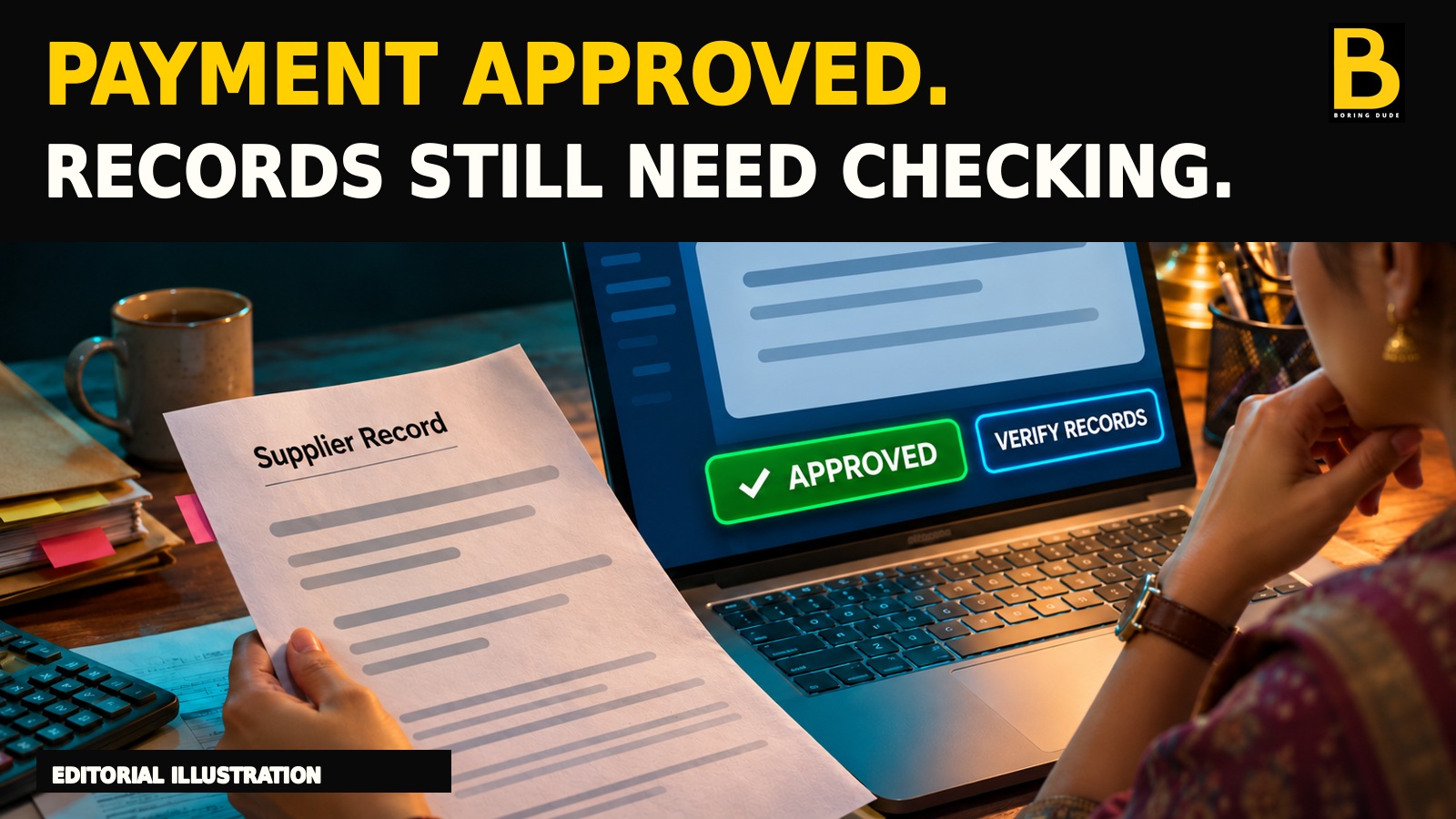
Consider an illustrative supplier payment. A finance reviewer sees a valid invoice, a recognised supplier name and an approved workflow. Before that review, someone has changed the destination account. The reviewer can approve the invoice in good faith while the money goes somewhere the supplier never authorised.
This example is an explanation of the risk, not a reconstruction of an incident disclosed by CERT-In. The public warning does not provide enough case detail to recreate individual attacks. Its practical significance is that a successful software check and a legitimate business obligation answer different questions.
One question is whether the application accepted the transaction. Another is whether the intended recipient authorised the current instructions. A dashboard that answers the first question should not silently be treated as answering the second. That distinction belongs in requirements, review screens and operating procedures.
A useful comparison with invoice fraud
The FBI’s business email compromise guidance recommends checking changes to account numbers or payment procedures with the requester. It also advises finding a company’s telephone number independently, rather than using contact details supplied by a possible scammer.
That is background prevention guidance from the United States, not evidence about the Indian incidents. The connection is the verification problem: a convincing request may carry false instructions. A callback to an established contact can challenge a change, while replying to the same questionable message may simply return to its sender.
What developers and delivery teams can take from this
OWASP’s business logic guidance explains that software can follow its instructions and still violate the intended business process. A value can have a valid format while carrying the wrong business meaning. Generic scanning therefore needs to be complemented by review of the actual rules and workflow.
OWASP recommends enforcing sensitive values and workflow state on the server, rather than trusting the interface or client-submitted state. It also recommends testing misuse cases, including steps attempted in the wrong order. These are development practices, not a claim that one particular coding flaw caused the reported payments.
For a project manager or business analyst, a useful workshop starts with a concrete question: what must remain true before money leaves? The answer should name the authorised recipient, the approved instructions and the person entitled to change them. Writing only “payment must be approved” leaves too much unexplained.
Turn that question into reviewable work
- Describe the change. Make the old and proposed payment instructions visible to the reviewer, with a clear record of who requested the update.
- Define the evidence. Decide what establishes that the recipient approved the change. State which team checks it and where the result is recorded.
- Test the exception path. Ask what happens when the evidence is missing, disputed or unavailable before a payout deadline.
- Assign the decision. Name who can hold the affected transaction and who can release it after review.
This checklist is BoringDude’s suggested way to turn the warning into delivery questions. It is not a replacement for an organisation’s incident procedure or an assertion that these four steps guarantee protection. Teams should adapt the questions to their actual payment design and responsibilities.
Keep the AI finding separate
CERT-In also describes AI-driven offensive activity found during separate threat hunting. It does not establish that AI caused every payment incident in the advisory. Combining those observations into a headline about AI stealing an undisclosed sum would go beyond the evidence.
For readers following workplace AI, the distinction is useful. A capability announcement, a security observation and a confirmed incident are different kinds of evidence. Our coverage of Microsoft’s MAI coding models in GitHub Copilot concerns developer tools. It does not establish any connection between those products and this alert.
What remains unknown and what to watch next
The public record does not identify a complete victim list, a consolidated loss figure or a recovery total. It also does not establish that every vendor payout platform is compromised. Readers should resist turning an unspecified scope into a claim about the entire sector.
For affected organisations, useful follow-up evidence would include a named incident disclosure, the period of exposure, the records involved and confirmed remediation. For customers, a provider-specific notice would be more actionable than assuming that this broad advisory describes their own account.
The immediate editorial conclusion is narrower: India has a fresh warning about abuse of trusted payment workflows. The practical response starts by examining how payment instructions become trusted, who can change them and what evidence a reviewer sees before authorising a transfer.
Frequently asked questions
Did CERT-In name the companies involved?
No. The sources reviewed do not identify a complete list of affected organisations.
How much money was lost?
No consolidated loss figure was disclosed in the advisory or the Reuters report reviewed.
Did AI cause all the payment incidents?
That is not established. The advisory presents separate AI-assisted intrusion observations.
Is the supplier example an actual incident?
No. It is an illustrative explanation of how a changed payment instruction can affect a legitimate workflow.


Happy
0 %

Sad
0 %

Excited
0 %

Sleepy
0 %

Angry
0 %

Surprise
0 %
 0
 0

Average Rating